
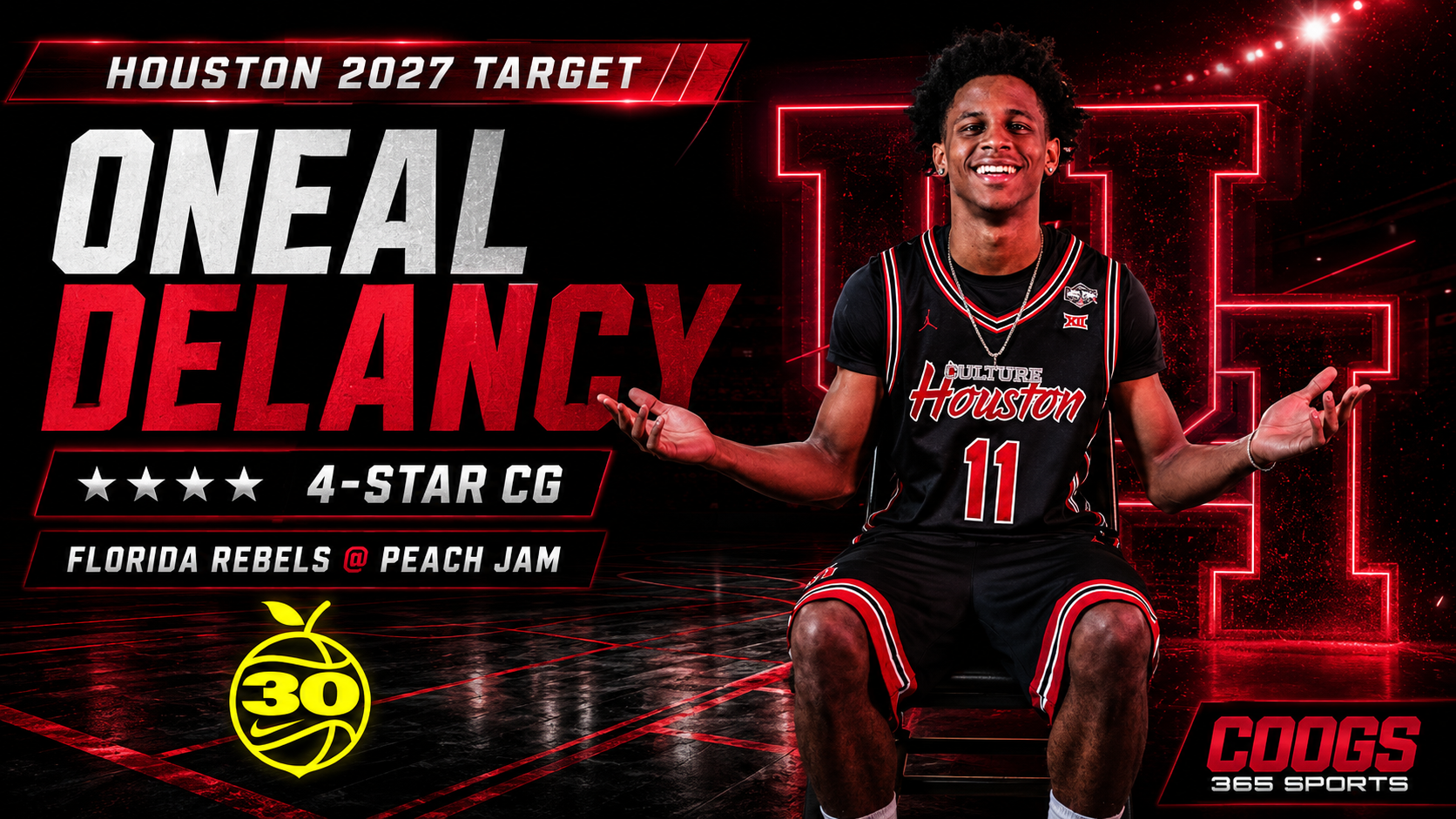
NORTH AUGUSTA, S.C. — Watch him early, before the game has decided what kind of game it wants to be. Watch the first time Oneal Delancy walks the ball up against a set defense, because that is where a scout's whole evening either gets interesting or doesn't. Some guards attack the first crack of daylight they see. Delancy waits. He'll take two dribbles above the arc, let the defense declare itself, and only then decide whether the seam is his to split or someone else's to finish the mark of a player who has already learned the hardest lesson in basketball, which is that patience is not the same thing as hesitation.
That is the version of Delancy who takes the floor tonight for the Florida Rebels against Team Melo, Carmelo Anthony's program watching from the bench the way it has each July since Melo traded a jump shot for a clipboard.
The opening tip of a tournament that has decided the shape of more college rosters than any other week on the calendar and the biggest stage yet for a 6-foot-2 combo guard that Kelvin Sampson's Houston program has spent a year now trying to make its own.
THE FILM
Strip away the recruiting rankings for a second—the No. 48 overall spot, the No. 8 combo guard nationally, and the No. 9 tag out of Florida—and look instead at what the tape and the box score actually say about how Delancy plays.
The shooting profile is the first thing that jumps off the page: 45 percent from the field, 38 percent from three, 83 percent from the line. That last number matters more than people give it credit for. Free-throw percentage is one of the more reliable predictors of whether a young shooter's stroke will hold up against longer, faster college closeouts, and 83 percent suggests Delancy's mechanics are sound enough to survive the jump. Combine that with 17.2 points a game on efficient volume, and you have a guard who has already solved the fundamental math problem of the position: score without needing thirty shots to do it.
The playmaking is the more interesting study. Delancy is averaging 3.4 assists to go with his scoring, modest by pure point guard standards but notable for a player whose primary usage is still as a scorer.
Watch him in ball-screen actions, and the appeal becomes clearer: he reads the screener's man rather than the ball, which is what allows him to play either backcourt spot without the offense needing to be rebuilt around him. That is the "combo" in combo guard, not a hedge on what position he plays, but a real, live option to play both.
The 1.1 steals a game point by instinct as much as effort, the kind of anticipation that shows up more in deflections and passing-lane reads than in a highlight package.
The honest scouting question, the one every one of his five finalists has almost certainly asked in the film room, is what happens to a 6-foot-2 guard's driving game against college length. Delancy's advantage in high school is that he is simply faster and smarter than what's in front of him. That edge narrows in the Big 12 or the SEC or the ACC. The programs recruiting him hardest are, not coincidentally, the ones with a track record of adding strength and shot-selection discipline to guards without sanding down what made them dangerous in the first place.
THE FIT
Which is precisely Houston's pitch and precisely why Sampson's name keeps surfacing in Delancy's own account of his recruitment. Sampson's offense does not ask a combo guard to be the star; it asks him to be relentless to guard the ball for 94 feet, to make the simple read before the difficult one, and to accept that shot attempts are earned, not entitled. It is a system that has taken guards with real but unrefined tools and sent them out the other side sturdier, more complete, occasionally unrecognizable from the player who walked in. Delancy has clearly done his homework on that history.
"The tradition and the discipline of Coach Sampson is legendary. His development of guards is top notch. He is a legend and inspirational," Delancy said.
"Houston definitely stands out," he added, calling himself "so blessed to have an offer and interest from them" — words that read less like recruiting-trail diplomacy than an actual, considered opinion, which is rarer than it sounds this time of year.
Delancy has been just as direct about what will ultimately decide things, and none of it lives on a stat sheet.
He is looking, he says, for "a family atmosphere, strong team culture, team building, and a home to grow and develop as an athlete and a person. Great facilities and great people who really want me to be successful and a part of a winning, hardworking team."
Having completed official visits to Houston, Florida, Maryland, Ohio State, and Florida State, he has now seen each program's version of that pitch delivered in person. What is left is the harder work of sorting genuine fit from a well-rehearsed one.
None of that gets settled in a gym in North Augusta. What gets settled, or at least tested, is whether the patience in his handle holds up when the stakes and the competition both rise a level or whether the pull-up he trusts in July trusts him back in the moments that count.
The Rebels enter Peach Jam at 13-2, and a step-up performance against Team Melo would do more to answer the scouting question than any highlight reel from the regular season.
The five schools on his list will be watching from their seats or their group chats either way. For one night, though, the only opinion that needs forming belongs to whoever is guarding him.
Coogs can catch Oneal in action with Tip at 7:30 p.m. ET on Gym 2 at Riverview Park Activities Center, streaming live on the Nike EYBL website: https://nikeeyb.com/peachjam-day1.