
Strip football of its marching bands, its autumn pageantry, and its roaring cathedrals, and the game reveals its ancient, unadorned core: a violent dispute over real estate.
Nowhere is that argument waged with greater malice than inside the 20-yard line. The boundary line shrinks, the safeties abandon the sky to crowd the turf, and drives built on long afternoons of sweat often wither into the dust of field goals.
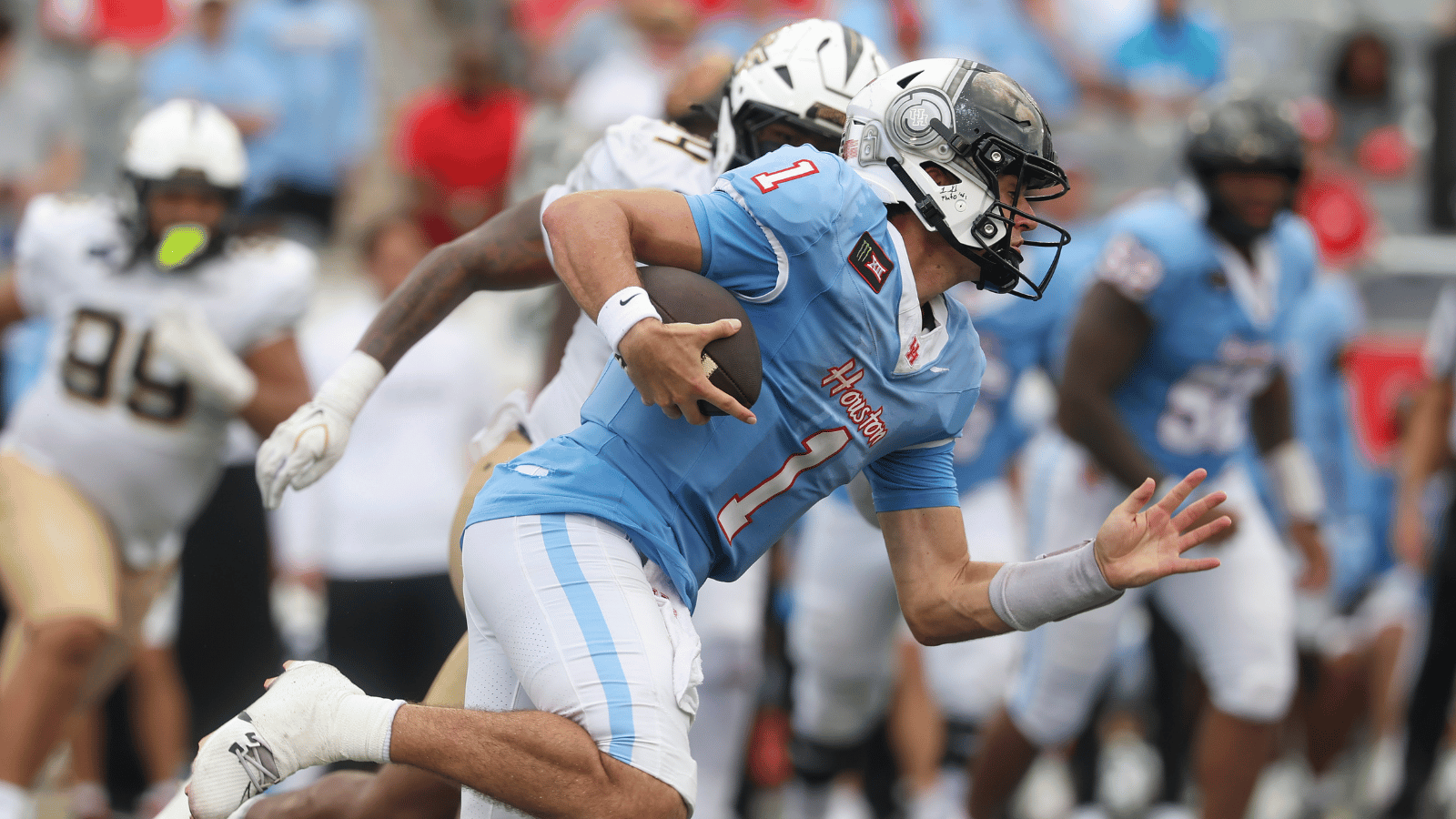
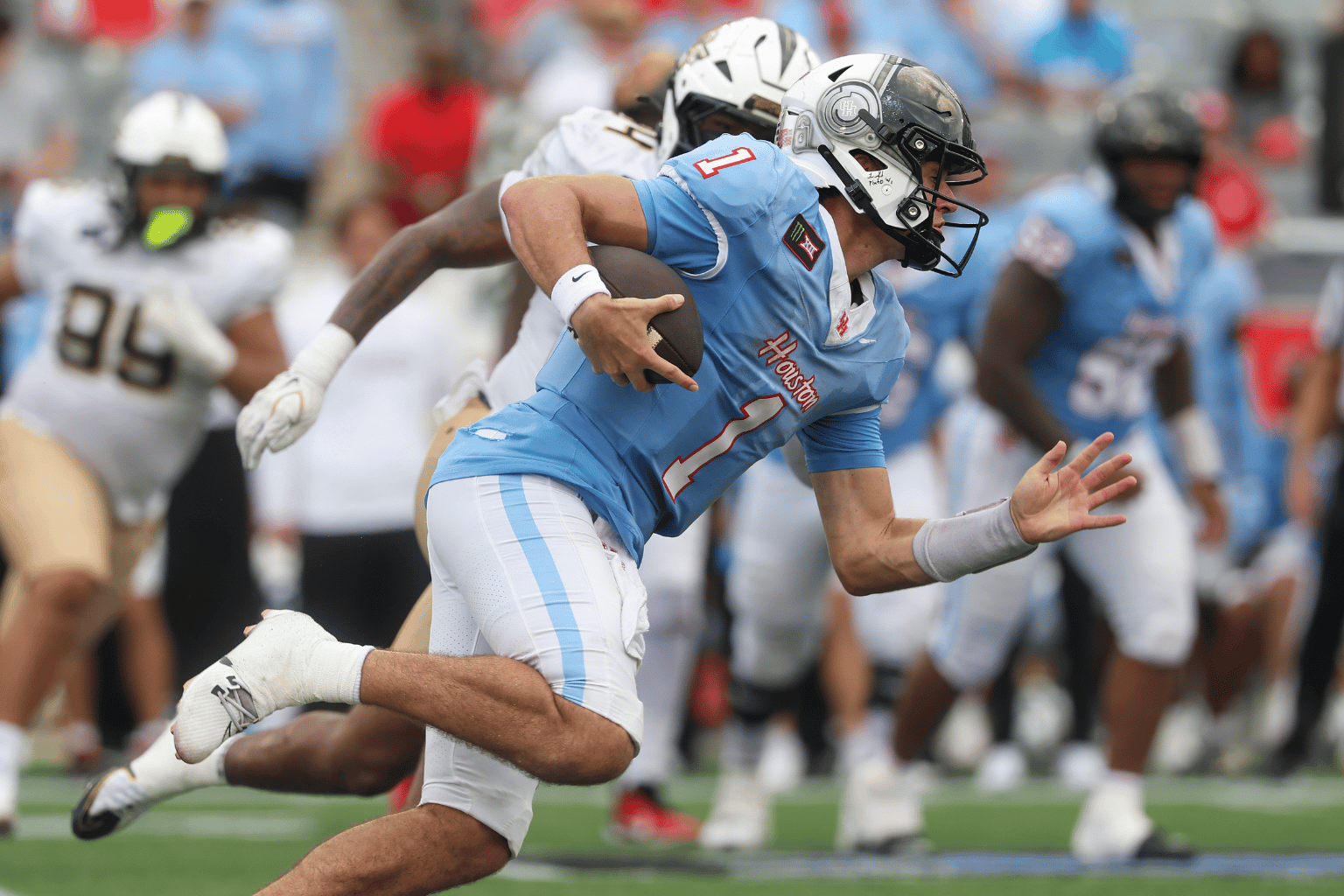
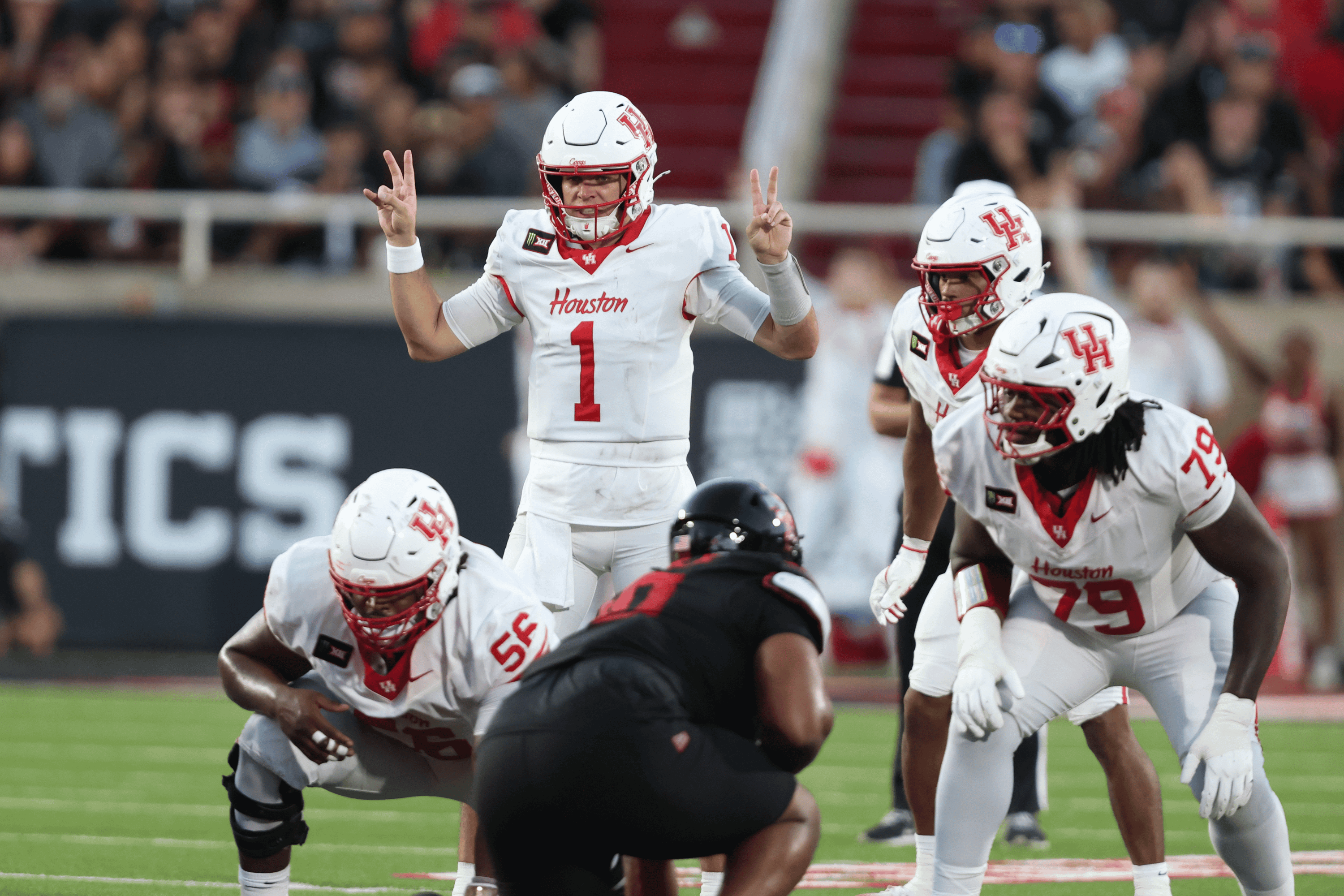
Yet on Saturday afternoon at Bill Snyder Family Stadium, Conner Weigman and Patrick Overmyer found a quiet room of their own. Four red-zone trips. Four surgical incisions. Four strokes of the brush.
Houston’s 35-16 dispatching of Kansas State delivered a profound tactical seminar that should command notice far beyond the Big 12 footprint. What transpired in the Flint Hills was not merely a victory; it was a clinical study in what happens when a quarterback understands coverage geometry and a converted-passer tight end executes with route-running precision.
https://twitter.com/UHCougarFB/status/2109038251130437805?s=20
The First Stroke: Leveraging the Rub Against Man-Free
Against aggressive Cover 1 (man-free) or banjo bracket calls, the red zone becomes a game of contested releases. Houston dictated the terms before the ball was ever snapped.
Motion unmasked the Wildcats’ leverage, forcing the defensive backs to declare their coverage roles early. From there, Houston dialed up a classic goal-line rub concept, weaponizing the compressed vertical space to flood pursuit angles with natural traffic.
Here is where the film-room discipline surfaced: Overmyer didn’t hurry.
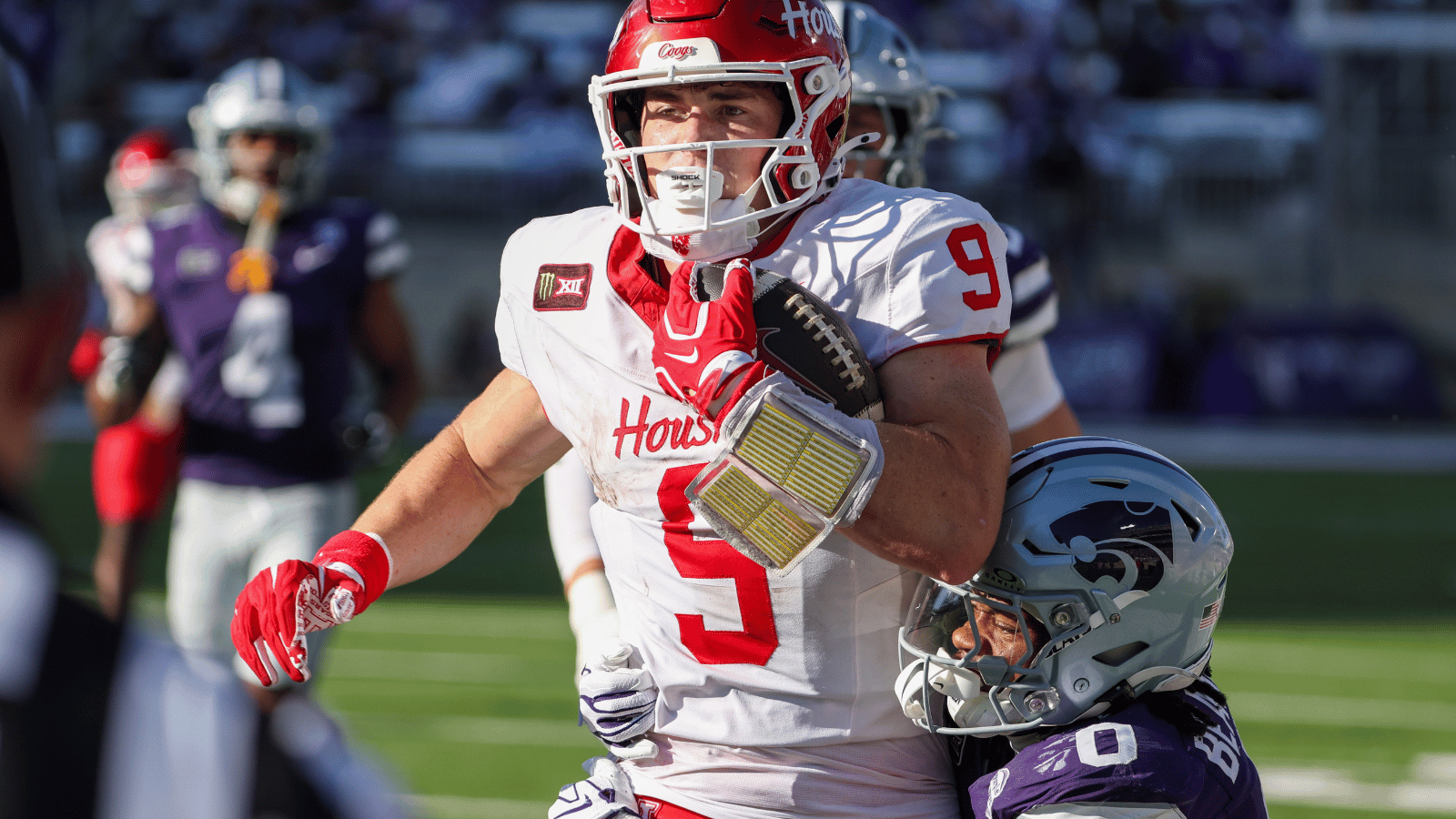
A tight end who rushes his track through traffic inevitably outruns his screening blockers and trails the defender straight to the catch point. Overmyer delayed his stem by a half-beat, allowing the traffic to clear like a pull block developing on power. The moment the trail defender collided with the natural wash, Overmyer broke clean into the boundary pylon. Weigman placed the ball where only his man could reach it.
Separation in the red zone is rarely about 40-yard dash speed; it is about timing, landmark integrity, and spatial awareness.
The Second Stroke: High-Low Conflict on Zone Integrity
Adjusting to Houston's man-beaters, Kansas State retreated into zone coverage to choke the passing lanes. Houston immediately attacked the inherent stress point of the scheme with a high-low concept designed to isolate the underneath curl-flat defender.
The fundamental flaw of zone coverage inside the 15-yard line is that an underneath linebacker or nickel has to defend two vertical planes at once. Weigman engineered the play with his eyes. By freezing the underneath defender with his front shoulder aimed toward the flat, he kept that defender glued to the shallow grass.
That subtle nuance created an open window right behind the defender’s earhole and underneath the apex safety. Overmyer snapped off the route, flattening into the open pocket of grass.
Crucially, Weigman released the ball before Overmyer even turned his head. If a quarterback waits until a receiver flashes open in the low red zone, the closing safety gets a decisive vote. Weigman threw to a landmark; Overmyer arrived on time.
The Third Stroke: The Quarterback Mindset at Tight End
The chemistry between Weigman and Overmyer is not happenstance; it is cerebral. Before transforming into a 6-foot-5, 240-pound receiving problem for the Cougars, Overmyer lined up under center at Kingwood Park.That pedigree changes the equation.
A former quarterback running routes understands why a five-yard out cannot be rounded off at four, why defensive leverage alters an stem angle, and why drifting a single extra yard destroys a throwing lane. Overmyer knows what the man holding the football sees because he has stood in those exact cleats.
When Kansas State rolled an apex defender to crowd the hash, Overmyer instinctively bent his vertical stem outside to maintain the throwing lane. He did not fight for grass that belonged to the safety. He claimed the void. Weigman anticipated it; Overmyer fulfilled it. Both men arrived at the chalkboard solution before the defense could react.
The Final Stroke: Leverage and the Art of the Body Shield
On the record-tying score, the Wildcats knew where the ball was heading. They bracketed Overmyer over the top and underneath, daring Weigman to challenge double coverage in the tightest boundary corridor on the field.
Weigman’s answer was pure ball placement: a back-shoulder laser delivered away from the leverage of both defenders. Overmyer sealed the play with veteran post-up technique. Using his 240-pound frame the way a seasoned power forward boxes out on the glass, he made his body a physical barrier between the defender and the football, catching the ball through contact outside his frame.
That score vaulted Overmyer into the NCAA FBS record books, tying the all-time single-game mark for touchdown catches by a tight end (4) and eclipsing Mark Hafner’s school standard set back in 2008 at Houston.
The Impasse Waiting for Oklahoma State
The film Kansas State left behind presents a glaring dilemma for defensive coordinators across the country, beginning with Oklahoma State this Saturday at TDECU Stadium.
Play man coverage, and Houston will scheme picks and rub routes that turn the short field into an impassable traffic jam.
Drop into zone, and Weigman’s eyes will hold underneath defenders long enough to drop intermediate darts behind them.
Bracket the tight end, and the size-and-ball-placement calculus renders double coverage irrelevant.
Every defensive adjustment carries an inherent structural concession. In Manhattan, Conner Weigman and Patrick Overmyer identified every one of them before the snap and exploited them before the window closed.
The Cowboys will dissect every stroke on the game tape this week. But identifying the brushwork is one thing.
Finding an eraser for Weigman and Overmyer is quite another.