

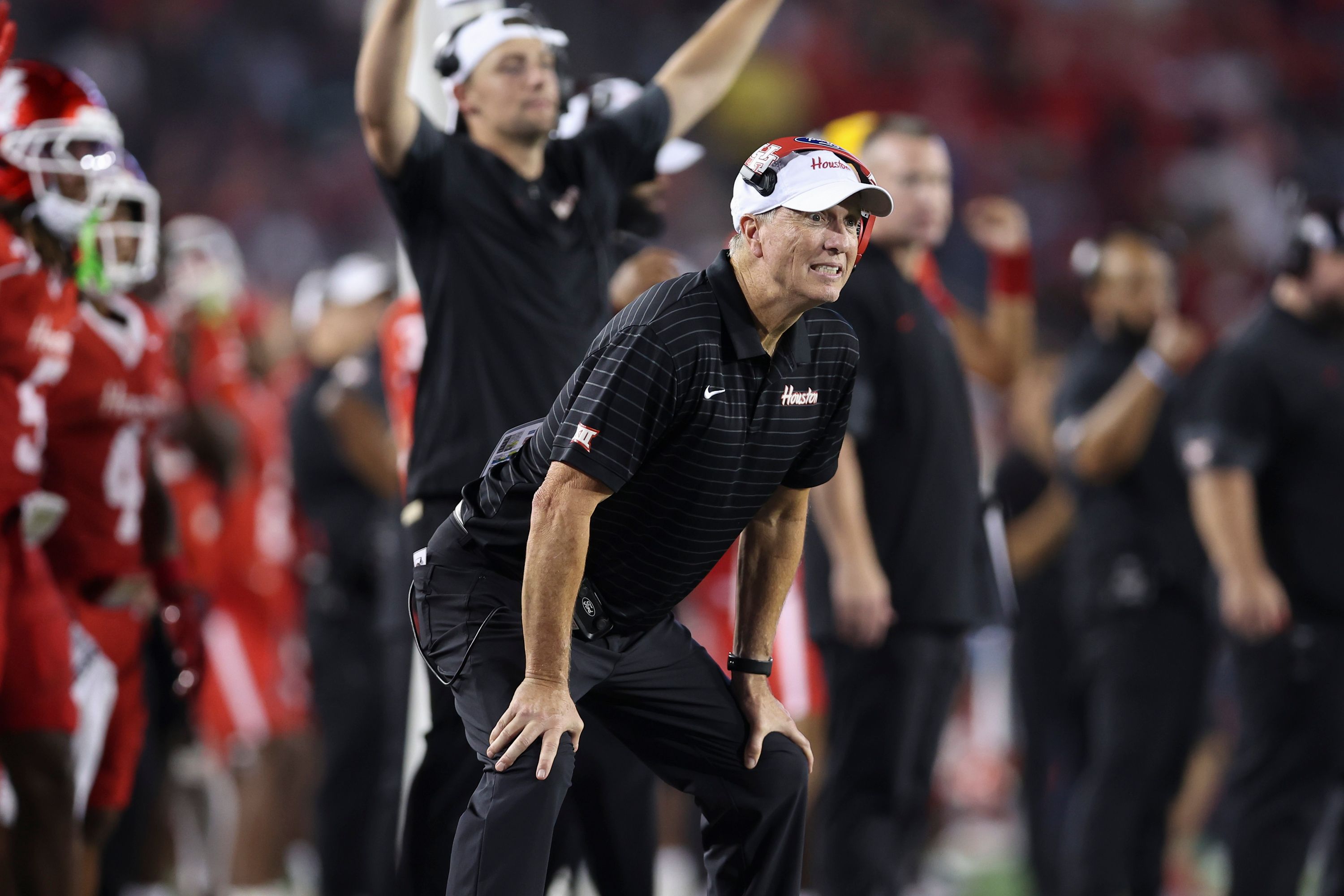
There is a difference between arriving and taking control. There is a difference between winning ten games and becoming the kind of program that expects to play for championships. Houston crossed the first threshold last season.
The Cougars won ten games, finished fourth in the Big 12, beat LSU in the Texas Bowl, and closed the year inside the national rankings. They went 6-0 away from home, the only team in the country to finish unbeaten on the road while delivering Willie Fritz a six-win improvement from the year before. That was the breakthrough.
Now comes the burden of belief.
Houston will not enter 2026 as an entertaining surprise or a rebuilding program playing ahead of schedule. It will enter carrying preseason honors, a roster built to contend, and a target it has never worn before.
There is a quiet, well-documented trap that comes with that shift. Teams that move from underdog to favorite often play tighter, not because the talent changes but because the stakes do. Chasing a win rewards aggression.
Protecting a lead rewards caution. Houston's 6-0 road record last season was built by a team with nothing to defend. In every one of those games, the Cougars played to win, not to survive. In 2026, for the first time under Fritz, Houston will spend Saturdays with something to lose. That is the opponent no depth chart accounts for, and learning to play like the hunted without playing scared is the first test of the season.
Houston has more than 32,000 career snaps spread across its roster, three preseason All-America candidates, and a quarterback whose 36 total touchdowns last season are the most among returning Big 12 quarterbacks. The Cougars also return Fritz, offensive coordinator Slade Nagle, defensive coordinator Austin Armstrong, and the infrastructure responsible for last season's climb.
The foundation is no longer theoretical, but championships are not won by collecting returning production, preseason recognition, or portal rankings. They are won by becoming the most complete version of yourself at the exact moment the season demands it.
For Houston, that transformation begins with Conner Weigman.
Weigman Must Become More Than the Reason Houston Can Win
Weigman was one of college football's most productive dual-threat quarterbacks in 2025. He completed more than 65 percent of his passes, threw for 2,705 yards and 25 touchdowns, and added 700 yards and 11 more scores on the ground, one of only four FBS quarterbacks with at least 25 passing touchdowns and 10 rushing touchdowns.
Those numbers made him dangerous. The next evolution must make him inevitable. There will be afternoons when Houston needs Weigman to escape pressure, break containment, and turn a collapsing third down into a first down. There will also be moments when the most important play he makes is throwing the ball away, sliding before contact, or refusing to turn one mistake into two.
Here is the part that gets lost in the "protect the quarterback" argument: Weigman's value as a runner was never only the yards he gained. It was the hesitation he created in every linebacker reading run-pass on third down. A quarterback who has proven he will pull the ball and go earns extra defensive attention on every snap, including the ones where he simply hands it off.
Weigman doesn't need fewer called runs. He needs Houston to stop needing him to invent yardage out of broken plays, the unscripted, high-contact scrambles born from protection failures rather than design. The threat should stay. The desperation should not.
A championship quarterback does not simply create offense. He controls the emotional temperature of a game, understanding when Houston needs electricity and when it needs oxygen.
Last season, Weigman threw nine interceptions and carried a heavy share of the rushing load. His mobility is one of Houston's greatest weapons, but a national run cannot be built on repeatedly exposing the most important player on the roster to unnecessary contact.
Houston needs his legs. It needs his availability more. Weigman does not have to become a different quarterback. He has to become a more selective one, a player capable of producing the spectacular without becoming dependent on it. Because in the biggest games, particularly on the road, Houston will not always need a superhero. Sometimes it will need a closer look.
Houston Must Build an Offense That Travels Without Conditions
The Cougars averaged 29.1 points and 394.5 yards per game last season. They ran for 178.1 yards per contest, controlled possession for more than 32 minutes per game, and converted better than 40 percent of their third downs. Those are the statistics of a good offense.
Going the distance will require a more ruthless one. Houston scored on 43 of its 47 red-zone possessions, but only 31 ended in touchdowns. The Cougars made 21 field goals, a mark of dependable special teams but also a record of how often promising drives ended in three points instead of seven.
Run the math on that split: twelve trips into the red zone came away with a field goal instead of a touchdown, a gap worth roughly four points a possession. Houston's three-point loss at TCU sits inside that number; exactly one settled-for field goal turned into a touchdown is the difference between a signature road win and a loss. That is not bad luck.
It is a fixable inefficiency, and it doesn't require a single new player because it doesn't live between the 20s. It lives inside the 10, where the field shrinks and every advantage Houston built earlier in the drive has to survive in a smaller space.
The arrival of Shadre Hurst, Anthony Boswell, and Drew Terrill gives Houston a chance to change the offense's physical identity. Hurst was one of the nation's highest-graded guards last season; Boswell arrives after first-team All-MAC recognition and one of the best run-blocking grades among FBS centers.
Their job is bigger than protecting Weigman. They must give Houston ownership of the game.
There's a quieter risk buried in an offensive line built partly through the portal, though: continuity. A grade measures individual talent. It doesn't measure how quickly five new combinations of hands, calls, and eye contact become one unit that reacts on instinct instead of assignment. Houston's line will look excellent on paper in August. Whether it looks that way in November usually comes down to how many series it played together in September, not to any single player's rating.
The Cougars allowed 28 sacks last season. For Houston to reach Arlington and play beyond it, that number has to fall so Nagle can call the full offense on third down instead of repeatedly escaping long-yardage emergencies.
That is where Makhi Hughes can change the geometry of the season.
Hughes arrives with 2,849 career rushing yards and a track record inside Fritz and Nagle's system. In his final full season at Tulane, he rushed for 1,401 yards, finishing among the nation's top ten rushers.
He gives Houston more than another ball-carrier. He gives the Cougars a true four-quarter identity, a way to lighten Weigman's physical burden, force defenses to commit extra bodies to the box, and open the isolation opportunities Amare Thomas needs downfield.
Thomas is already one of the Big 12's most dangerous receivers. He finished last season with 966 yards and 12 touchdowns, six of them covering at least 20 yards during the regular season.
The next challenge is making sure defenses can't build their entire plan around removing him. Trent Walker, Patrick Overmyer, and the rest of Houston's receiving corps have to punish every bracket, safety rotation, and coverage tilt designed to take Thomas away. Houston cannot simply have weapons. It has to make every defensive answer wrong.
The Defense Must Progress From Reliable to Disruptive
Houston's defense was one of the central reasons the Cougars won ten games. Opponents averaged 22.9 points and 347.8 yards. Houston held teams to 129 rushing yards per game, allowed only 16 passing touchdowns, and forced opposing offenses to convert fewer than 36 percent of their third downs.
That defense kept Houston balanced. A championship defense has to start tilting games. The clearest area for growth is the pass rush. Houston recorded 19 sacks last season while its own offense surrendered 28, a pressure differential that is hard to carry into a conference championship race.
The Cougars can't keep asking Austin Armstrong to manufacture pressure on every critical passing down. They need Brandon Mack II, Khalil Laufau, and the defensive front to win with four rushers, collapse the pocket, and force quarterbacks to unload before routes finish developing.
Sacks get filed as a pass-rush stat, but they're just as often a coverage story.
A quarterback doesn't take a sack because a tackle loses his rep for a moment; he takes it because there's nowhere else to go once that moment passes. A defense with a shutdown secondary manufactures sacks it never technically rushed for, simply by taking away every option before the pocket folds.
Houston already has the pieces to be that defense. Will James alone can turn one half of the field into a place quarterbacks don't want to look. Stretching that discomfort across the rest of the secondary may do more for Houston's sack total than any new stunt Armstrong draws up.
Pressure changes more than plays. It changes play-callers. When a defense generates disruption without blitzing, it keeps extra defenders in coverage, disguises intentions, and shrinks the field around the quarterback. It turns second-and-long into third-and-desperate.
Will James led the Cougars with three interceptions, four takeaways, and two forced fumbles last season. He enters 2026 as a preseason All-Big 12 selection alongside an experienced secondary that includes Javion White and Jordan Allen.
James gives Houston a player capable of erasing one side of the field. To become nationally relevant, the defense needs more than one player capable of changing possession.
The difference between a good defense and a championship defense is usually one sudden moment: a strip-sack before halftime, an interception in the red zone, a fourth-down stop that silences a stadium. Houston was disciplined and dependable last season. season. This year, it has to become feared.
The Road to Arlington Runs Directly Through Lubbock
Houston's 2026 schedule is not impossible. It is simply unforgiving.
The Cougars play five Big 12 road games and only four conference games at TDECU Stadium. Their league opener comes Sept. 18 against defending Big 12 champion Texas Tech in Lubbock. They also travel to Kansas State, Utah, Colorado, and West Virginia.
That Texas Tech game won't determine the entire season. But it will reveal how much Houston has actually changed.
There's a schedule Houston will play that never shows up on paper, too: the schedule of attention. A year ago, Houston was a trap a dangerous team most opponents underprepared for because a bigger name further down the calendar got circled first. That cover is gone. Every Big 12 staff will spend fall camp treating Houston as a team it has to game plan for, not one it discovers on a Tuesday in scouting.
The week after Lubbock is usually where that shift shows up first. Teams that survive a hostile road environment historically struggle the following week, not because the talent disappears, but because the adrenaline does. How Houston answers that letdown window may say more about the program's ceiling than the Texas Tech game itself.
The Red Raiders handed Houston its most decisive defeat last year, winning 35-11. The Cougars also lost a shootout at West Virginia and a three-point grinder against TCU. Each loss exposed something different: the inability to match an elite opponent's force, the inability to regain control of a high-scoring game, and the inability to manufacture one final answer in a low-possession fight.
Those losses aren't scars Houston needs to hide. They're instructions.
To win the Big 12, Houston has to become capable of winning every kind of football game: surviving 38-35 when the field is open and quarterbacks are trading touchdowns; winning 17-14 when every possession feels dragged through concrete; and walking into a hostile stadium, absorbing the first surge, and refusing to let the opponent decide what kind of night it becomes.
Houston's unbeaten road record last season proved the Cougars are comfortable traveling. Now they have to prove they can dominate where championships are usually lost.
The Smallest Details Will Decide the Largest Dream
The 12-team College Football Playoff changes the scale of what's possible. Houston doesn't need perfection to enter the national conversation. Winning the Big 12 provides a direct path into the field; an exceptional season without a conference title could still build an at-large case. The 2026 postseason keeps the 12-team structure, with opening-round games on campus and the national championship set for January 25, 2027, at Allegiant Stadium in Las Vegas.
The expanded playoff doesn't make Houston's task easier. It makes every detail more valuable.
A missed protection in Lubbock can be the difference between controlling the conference race and spending November chasing a tiebreaker. A red-zone field goal at Utah can be the four points Houston wishes it still had in the fourth quarter. One lost edge on special teams can be the moment that separates playing in Arlington from watching it.
Fritz has built his career on details: field position, situational football, discipline, toughness, and staying emotionally steady when a game turns chaotic. Houston reflected those principles last season, committing only 40 penalty yards per game and closing out enough one-score games to matter.
Those habits have to remain. The margin for error will not. Houston is talented enough to win the Big 12. It is experienced enough to reach the College Football Playoff. It is dangerous enough to make the national establishment uncomfortable.
But going the distance will demand something greater than talent. It will require Weigman to become a closer, the offensive line to create control, Hughes to give the offense balance, Thomas to command coverage, the defensive front to generate pressure, and the entire roster to withstand the long physical cost of a championship season.
Last year, Houston proved it could rise. This year, the Cougars have to prove they can remain standing once everyone else understands the threat.
That is the final distance between a breakthrough and a championship. And for the first time since Houston entered the Big 12, that distance no longer feels impossible.
It feels close enough to chase.


