
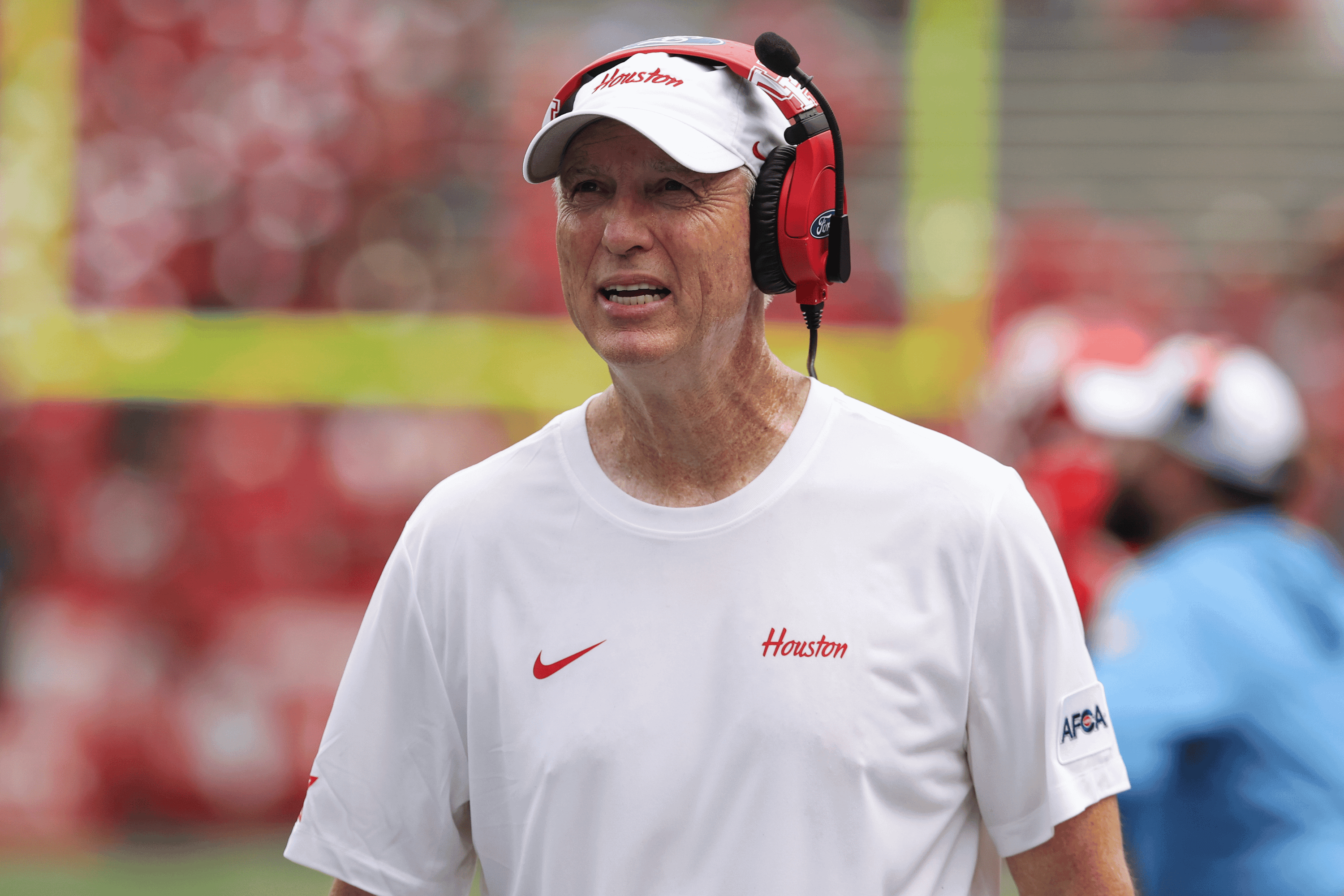
Outlined against a bruised Houston sky, thick with the kind of September humidity that turns a fourth quarter into a gut-check, Willie Fritz's football team did something more dangerous than winning. It looked comfortable doing it wrong.
Four-and-eight was the record two Augusts ago, back when Fritz was still a name Houston fans were learning to pronounce with confidence. Ten-and-three followed, with a bowl trophy to close it out. Neither number captures what actually happened Saturday, when the Cougars piled up 533 yards on Oregon State—their heaviest offensive night since 2023—while giving up enough on defense that the final score flattered the performance more than the performance deserved. Houston won by 13.
The tape says it could have been closer and also says it could have been a great deal further out of reach. That contradiction is the whole ballgame.
Run the offensive ledger like a play sheet. Conner Weigman threw for 305 yards and put a touchdown on the board with his arm and another with his legs—the only quarterback in the Big 12 to do both in the opening week. Amare Thomas ground out 133 yards between the tackles.
Patrick Overmyer, split out of an in-line tight end alignment, turned matchups into 84 receiving yards. Houston didn't ask one back to be a workhorse; it rotated Makhi Hughes and Re'Shaun Sanford by design, and Sanford made the defense pay for the lighter box with a 56-yard touchdown run. Total damage on the ground: 228 yards, against a front that was supposed to make Houston earn every one of them.
None of those names walked into Houston as a five-star headline. That's not incidental—it's the operating philosophy. Modern roster-building is mostly a transaction ledger now: who outbid whom in the portal, whose collective wrote the number that closed the deal, and which staff won December's news cycle.
Houston's Saturday ran on a different mechanism entirely—call it player development showing up on schedule. Javion White, a transfer out of Tulane, logged the first two sacks of his college career. Latreveon McCutchin generated five pressures off the edge. When starting corner, Drew Terrill went down, and Ronnell McLain rotated in cold and played 59 snaps without surrendering a single pressure. That's not a unit that got purchased into existence. That's a bench that got coached up long before it was needed and cashed in the moment it was.
Now put the red pen where it belongs, because the analyst's job isn't to admire a highlight reel. Oregon State threw for 376 yards on this defense. Fritz said as much afterward—the tackling lacked leverage, angles were late, and some of the coverage busts came against route concepts a Big 12 secondary shouldn't be losing track of in September. Add the penalties. Add the turnovers. On raw fundamentals, this was not a complete performance, and nobody in the building is going to tell you otherwise.
Here's the uncomfortable math for anyone still filing Houston under a feel-good story: a team that wins by two scores while playing that loose still has a governor sitting on top of its own engine. Tighten the tackling angles, clean up the leverage issues, and cut the giveaways in half—and the same offense that just hung 533 yards on somebody is now playing behind a defense that isn't bleeding chunk plays.
A polished, error-free 33-20 win would have told the rest of the conference that Houston had already found its ceiling. An ugly 33-20 win, with this much production sitting on top of this many correctable mistakes, tells the conference the opposite.
Which is why the No. 22 next to Houston's name reads like an outdated scouting report.
Texas Tech gets talked about as the Big 12's marquee swing this fall. BYU gets talked about as established. Houston still gets filed the way a team gets filed when the last thing anyone remembers clearly is 4-8—a nice story, worth keeping an eye on—even though the roster on the field has already outgrown the file.
Southern is next on the schedule, and it will get Houston's undivided attention, because this is not a program that skips steps to get to the marquee matchup. But one week past that sits Lubbock at Galaxy Stadium, a Friday night, and a wind that doesn't so much blow through West Texas as arrive with an opinion of its own. No. 13 Texas Tech will be the first opponent all year built to make Houston pay, snap for snap, for every leverage issue it hasn't corrected by then. Houston doesn't need to win that argument in advance.
Outlined against a different sky now—flatter, harder, colder than the one over TDECU on Saturday—Houston is about to find out exactly how much of that 533 yards was real and how much of that leaky secondary was fixable. So is everyone still filing this program under the nice story? Programs that get bought announce themselves in July. Programs that get built announce themselves in Lubbock.