
Most safety breakdowns start with a box, a stopwatch, and a highlight tape. Jordan Allen has to start somewhere else: at cornerback. Before he was Houston's veteran centerpiece on the back end, Allen was a three-star corner prospect out of Lafayette Christian Academy — the No. 20 overall recruit in Louisiana — and his first meaningful role in the SEC came at slot corner, not safety. That detail isn't trivia. It's the key to why his game looks the way it does five years later, and it's the piece most previews on him skip entirely.
The Positional Arc: How a Corner Became Houston's Eraser
Allen's development reads like a scouting department's case study in positional flexibility. As a true freshman at LSU in 2022, he played 47 defensive snaps — 34 of them at slot corner — logging a 66.1 PFF coverage grade that ranked fourth among all SEC true freshman corners with at least 40 snaps. By 2024, he'd been fully repositioned to safety, starting the season opener against USC at free safety before starting the very next week against Nicholls at strong safety. That in-season flip between the two spots is rare even for veterans; for a player still building his resume, it signals a coaching staff that trusted his processing speed enough to move him around at will.
By the time he arrived at Houston in 2025, that background had fully crystallized into his calling card. He started a career-high 13 games at weak safety, earned Dave Campbell's Texas Football Midseason All-Texas Second Team recognition, and became the connective tissue in a Houston secondary that finished 19th nationally in PFF coverage grade. The corner instincts never left—they just moved 10 yards deeper.
Reading Past the Overall Number
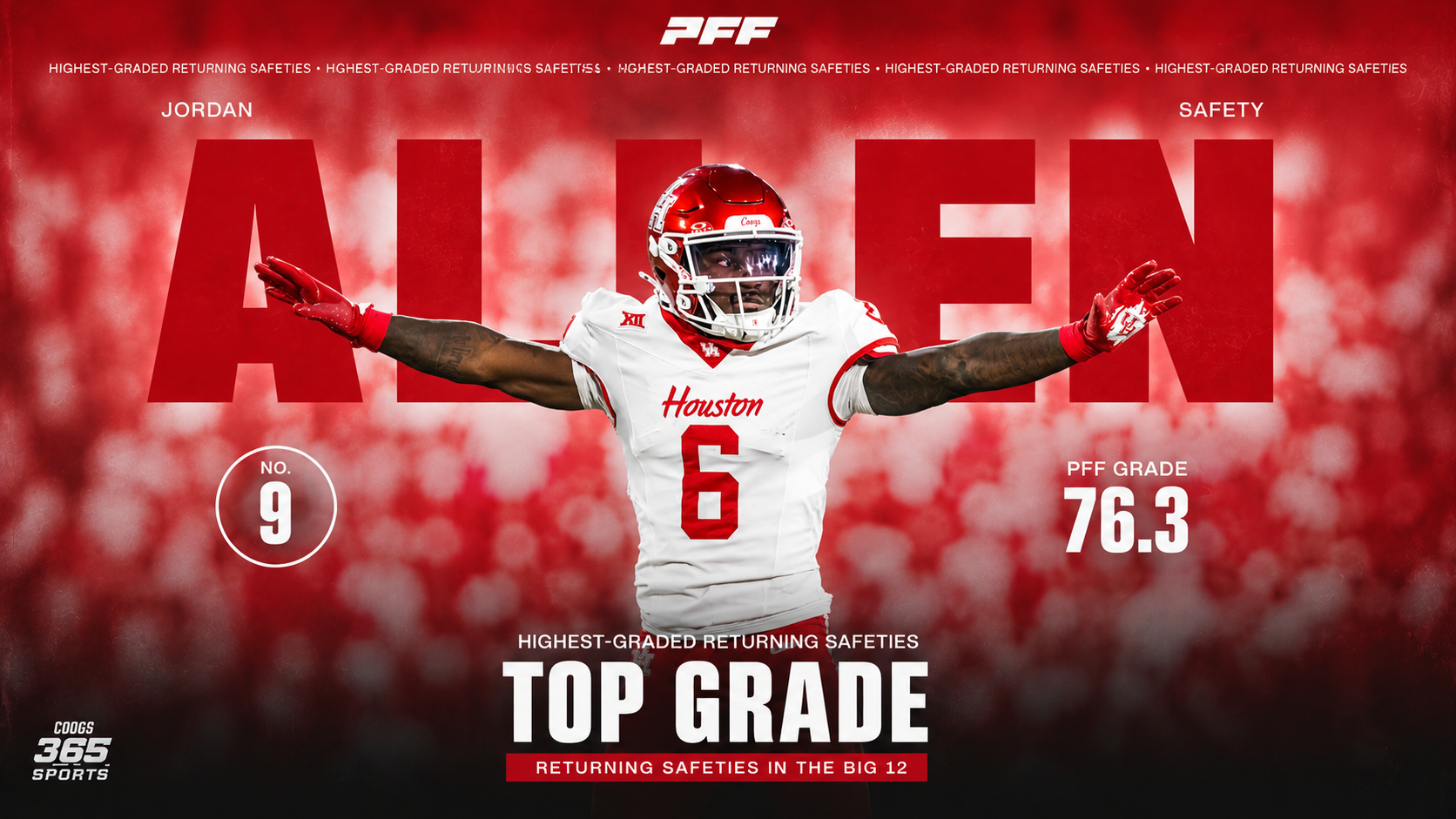
PFF's own preseason accounting has Allen at No. 9 on its list of top-graded returning Big 12 safeties, with a 76.3 overall grade—tied with Cincinnati's Jasper Beeler and behind names like Arizona's Cam Chapa (91.4) and UCF's Ty Bartrum (87.9). Taken by itself, that ranking reads as "solid rotation piece," not "X-factor." But an overall grade is a blend — coverage, tackling, run defense, and ball production averaged into one number — and Allen's is a case where the blend actively hides his best trait. Pull the tackling subgrade out on its own, and it's not ninth in the conference. He's fourth. The gap between those two numbers is the whole story of what kind of player he is right now and what he still has to prove.
Trait Breakdown
Range and closing burst. Safeties who came up playing corner tend to close on throws differently than converted linebackers or box safeties—a shorter first step, better hip transition, and less wasted motion. Allen's snap log backs this up: LSU trusted him in the deep half as a true sophomore, then Houston built its scheme around his ability to play multiple spots in the secondary without a drop-off in coverage discipline.
Tackling radius. This is where Allen's numbers separate from the pack—and where the No. 9 overall ranking undersells him most. His 7.4% missed-tackle rate in 2025 ranked second among all Big 12 safeties, and his 85.5 PFF tackle grade ranked fourth in the conference at the position and 16th among all Big 12 defenders — safety, corner, or box. That's a full 9.2 points higher than his overall grade. For a player generously listed at 5-foot-11, 200 pounds, that kind of tackling efficiency isn't about size. It's about angles, and it's the clearest evidence that his open-field instincts from playing corner translate directly into how reliably he brings ballcarriers down in space.
Run defense and disguise. Allen posted an 80.4 PFF run-defense grade that ranked fourth on Houston's roster, and the tape has flashes to match the number — most notably a November sack of TCU quarterback Josh Hoover off a disguised blitz, the kind of rep that never shows up in a "safety stats" column but tells you a coordinator trusts him to attack downhill, not just read and react.
The swing skill: ball production. Here's where a pro-style evaluation has to be honest instead of flattering, and it's also where that 76.3 overall grade earns its number. Allen's career includes just one pass deflection and zero interceptions dating back to his LSU days. For a player with a cornerback's coverage pedigree, that's a thin turnover resume, and it's the single biggest variable standing between "reliable safety" and "All-Big 12 difference-maker" in 2026. The tools for more are there—the question is whether the production catches up to the traits this season and whether that catches his overall grade up to the No. 4-caliber tackler he already is.
Scheme Value: Why Houston Built Around Him
Coach PJ Hall inherits a safety who can align anywhere from deep middle to the slot without tipping the picture pre-snap—a legitimate luxury in a Big 12 built on tempo and RPOs. Allen's ability to start at free safety one week and strong safety the next, as he did at LSU, gives Houston's defense a disguise element most rosters simply don't have at the position. He's not a system piece; he's the piece the system gets built around.
The Makeup Behind the Player
The scouting profile only tells half the story. Allen grew up in the same household as Malik Nabers—the LSU All-American wide receiver and 2024 NFL Offensive Rookie of the Year—describing him as a brother rather than a family friend. That competitive environment shows up in how Allen talks about his own game: asked to describe himself on the field in one word, he chose "versatile," the same trait that defines his tape. He picked Houston, by his own account, for the family atmosphere and a coaching staff he believed could maximize his ability—and a year later, he's become the veteran voice a retooling secondary leans on, mentoring newcomers like transfer corner Jalen Mayo through the jump to Big 12 speed.
Jordan Allen isn't Houston's X-factor because he's the flashiest name, he's the X-factor because his game was built backward from most safeties'. He learned to cover before he learned to tackle in the box, and that sequencing shows up in every rep: the closing speed, the missed-tackle rate, the willingness to blitz off the edge. PFF has him ninth among returning Big 12 safeties at 76.3 overall, and on paper that reads like a middle-of-the-pack veteran.
On tape, he's a fourth-ranked tackler in the conference with a coverage background most safeties never get. The one thing left to prove in 2026 is whether the ball production ever catches up to everything else. If it does, that No. 9 ranking won't survive the season — and Houston will be returning a player with a legitimate case for the best postiont player in the Big 12.