

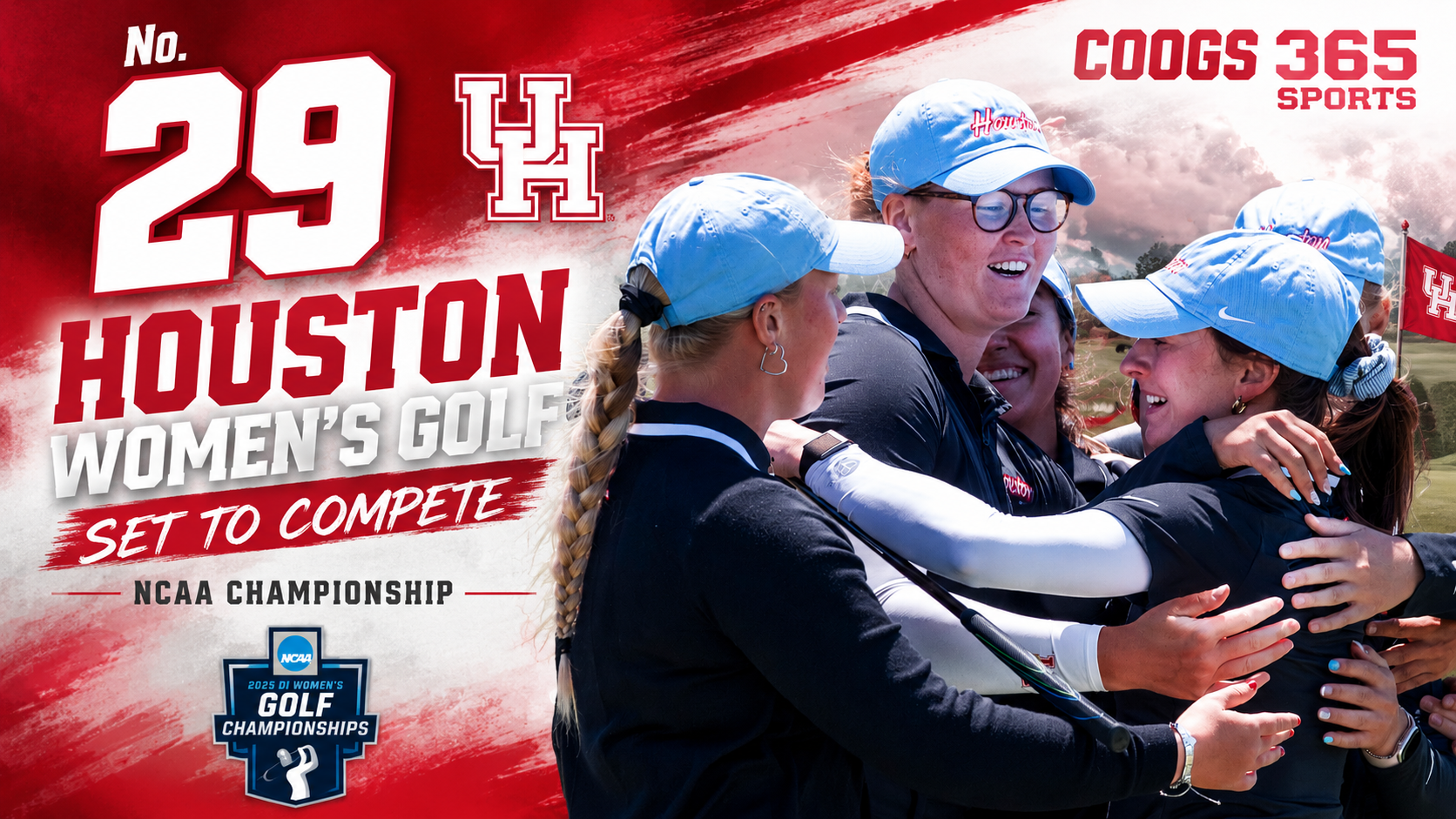
The stage gets bigger. The pressure gets heavier. The fairways tighten. Every mistake gets magnified, and yet, this feels exactly like the moment the University of Houston women’s golf program has been building toward.
When the No. 29 Cougars tee it up Friday morning at the NCAA Championships in Carlsbad, California, they won’t simply arrive as a feel-good story making its first-ever team appearance at college golf’s biggest event. Under head coach Lydia Lasprilla, Houston arrives looking like a program that belongs among the nation’s elite.
Programs can qualify for nationals. Elite programs expect to stay there.
This Houston team has all season long shown signs of becoming exactly that.
The Cougars punched their ticket to Omni La Costa Resort & Spa after a breakthrough performance at the NCAA Simpsonville Regional, finishing second at 11-under par and delivering a school-record postseason round of 275. But beyond the scorecards, the regional revealed something even more important about this roster: composure.
Houston did not simply survive the pressure. The Cougars looked comfortable in it.
That becomes critical this week because the NCAA Championships are unlike anything else in collegiate golf. Thirty of the top programs in America arrive with legitimate belief. Every lineup is stacked. Every grouping feels like an All-American showcase. And the format itself demands both endurance and adaptability.
First comes survival. Three rounds of stroke play cut the field from 30 teams down to 15. Then comes another cut. Only eight teams advance to match play, where national championships are often decided not by talent alone but by mentality, grit, and emotional control.
That is where Houston quietly becomes dangerous. This roster has veteran steadiness at the top, balance throughout the lineup, and players capable of getting hot enough individually to shift momentum across an entire tournament.
It starts with senior Moa Svedenskiöld, the emotional and competitive heartbeat of the program. The Sweden native enters nationals with a team-best 72.00 scoring average, five Top-10 finishes, and seven Top-20 finishes in her last eight tournaments. More importantly, she already understands the environment. After qualifying individually for the NCAA Championships a year ago, this week will not feel overwhelming.Championship golf punishes uncertainty. Svedenskiöld now plays with the confidence of someone who knows she belongs on this stage.
Then there is Natalie Saint Germain, who may quietly be playing some of the best golf of anyone in the field entering Carlsbad. The Prague native owns a 72.20 scoring average and has repeatedly elevated her play in major moments. She captured the Jim West Challenge individual title with three straight rounds in the 60s earlier this season and was the only Cougar to shoot par or better in every round of NCAA Regional play.Those are not accidental trends that is championship-caliber consistency.
Meanwhile, junior Maelynn Kim gives Houston another stabilizing presence capable of making a serious individual run. The Katy native has been one of the Cougars’ most reliable postseason performers, including shooting par or better in all three rounds of the Big 12 Championship. Her ability to avoid disastrous holes becomes invaluable in a championship environment where discipline often separates contenders from pretenders and that may ultimately define Houston’s ceiling this week.
Because while some programs arrive with more historical prestige or higher rankings, few teams may enter nationals with a cleaner identity than the Cougars.
Houston is experienced. Balanced. Mentally tough. Efficient. The Cougars do not beat themselves often.That travels in postseason golf. The challenge, of course, is enormous.
The field is loaded with national powers, including Stanford Cardinal women's golf, USC Trojans women's golf, Florida Gators women's golf, Texas A&M Aggies women's golf, and Texas Longhorns women's golf, among others. Every round will feel like a heavyweight fight. But Houston has already spent the past year proving it can stand in those conversations.
This program has steadily climbed from hopeful contender to legitimate national factor. The regional breakthrough was not the finish line. It was confirmation.
Now comes the opportunity to show the rest of college golf that Houston’s rise is sustainable.
Perhaps the most dangerous thing about these Cougars is this: for the first time in program history, they are not arriving at the NCAA Championships simply grateful to be there. They are arriving expecting to compete.
FORMAT
All schools will play 18 holes each day on the 6,373-yard, par- 72 course beginning at 8:30 a.m. (PDT), Friday and continuing through Sunday. Following the first three rounds, the Top-15 teams and Top-Nine individuals not on a qualifying team advance to the Final Round of stroke play.
The top individual following the Final Round of stroke play will be crowned the NCAA individual national champion.
The Top-Eight teams following the Final Round of stroke play advance to match play. The Match Play Quarterfinals and Semifinals will be held Tuesday, May 26 with the National Championship match beginning in the afternoon on Wednesday, May 27.
LIVE SCORING
Coogs can follow live scoring at the Championships by clicking here.
TUNE IN
Fans can watch coverage of the NCAA Championships first three rounds of stroke play as well as pre-linear during the final round of stroke play and the Quarterfinal round of match play prior to Golf Channel’s televised broadcasts.
All Babygrande-produced coverage can be found on BabygrandeGolf.com and will be simulcast across Golf Channel digital platforms. A subscription fee may be required.
Golf Channel is the exclusive television home of the NCAA Championships. Live broadcasts of the Final Round of stroke play begins Monday with coverage of all three match-play rounds on Tuesday and Wednesday. A subscription to Golf Channel may be required to view the live stream.