

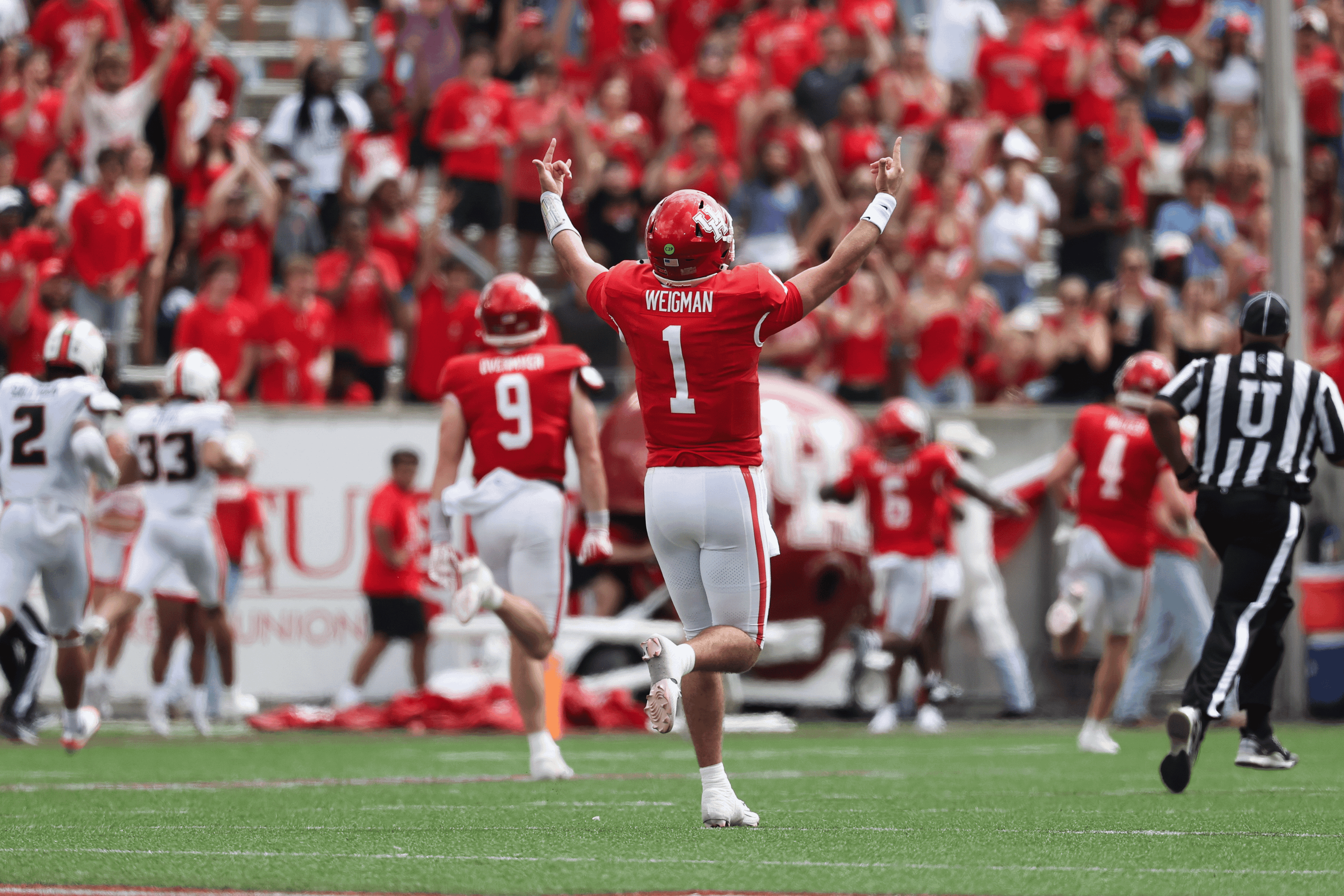
With 9:02 left in the fourth quarter at TDECU Stadium on Saturday, a 19-point Houston lead was six. AJ Newberry had just punched a 4-yard touchdown through Houston's front, and Oregon State—a team that opened as a 20.5-point underdog—had the ball back in a one-score game.
That sentence is not how the Houston Cougars' 33-20 season-opening win got written up Sunday morning. It got written up as a comfortable cover, a 533-yard offensive explosion, and a Conner Weigman coming-out party. All of that is true. It's also incomplete. No. 23 Houston outgained Oregon State 533 yards to 402, and a 402-yard defensive night against a team picked to finish outside the Pac-12's old upper crust is the actual story underneath the box score—one that matters a lot more this week than it did last week, because Houston's Week 2 opponent has spent the first two weeks of its own season proving it knows exactly how to live inside exactly that kind of window.
Southern arrives at TDECU Stadium on Saturday (6 p.m. CT) at 1-1, an FCS program that went 2-10 last year, hired an all-time great to rebuild it, and is not going to beat Houston. That part of this preview writes itself, and everyone else has already written it. What's more interesting—and what nobody's really connected yet—is what both teams' first games say about how they play with a lead, and why that, not the talent gap, is the actual variable in how ugly or how comfortable Saturday night gets.
The Play of Game One
Forget the final whistle. The play that decided Houston's opener happened on 3rd-and-6 from the Oregon State 42, seconds after the Beavers had trimmed a 19-point lead to six.
Houston's offensive line held up against an Oregon State blitz, buying Weigman just enough time to climb the pocket and put a ball up for 6-foot receiver Amare Thomas, who matched one-on-one against a 5-foot-11 slot corner. Thomas went and got it—a contested, 37-yard grab that traveled from midfield territory to the OSU 5. Two snaps later, Weigman snuck it in from a yard out, and a one-possession game was a two-possession game again with under six minutes to play.
Strip away the box score, and that's the moment the game actually turned—and it's worth sitting with why: it wasn't a called shot off a busted coverage or a broken tackle turned into a house call. It was a size mismatch, manufactured on purpose, and cashed in at the exact moment Houston needed someone bigger than the man across from him.
Thomas had already done it once in the first quarter—a 31-yard touchdown on which he broke two tackles for 24 yards after the catch. Twice in one night, at two completely different points on the field, Houston's answer to adversity was the same claim: throw it up to Amare Thomas, let him win it. Any team planning a game in Houston this season should assume that's not going away—least of all a Southern secondary that will be giving up several inches at the position where Oregon State just got beat.
The Recurring Tell
Here's the less flattering half of the tape. Houston's two lapses Saturday didn't come from being outplayed. They came from communication.
The first happened in the opening quarter, one series after Houston's opening touchdown drive: on the very next Oregon State snap, the Cougars had a coverage bust downfield, and sophomore quarterback Braden Atkinson — a first-year starter making his debut — found true freshman receiver Jesse Legree wide open for a 71-yard gain that set up Oregon State's only lead of the game. The second came in the fourth quarter, when Houston's defense allowed a clean, sustained scoring drive right as the Beavers needed one most.
In between, Houston's defense was excellent for the better part of three quarters. But both breakdowns were the same kind of breakdown—a coverage or leverage error, not a physical mismatch—and both happened at moments of maximum leverage: right after Houston had just scored and right when Oregon State most needed one. Houston coach Willie Fritz said as much without being asked to spin it, noting plainly after the game that the team still needs to get better defensively.
The box score makes the split almost comically specific: Oregon State finished with 376 yards through the air and just 26 on the ground, even while Houston's front sacked Atkinson four times. That's not a defense that got physically overwhelmed. It's a defense that erased an entire phase of the game—the run—and still bled chunk yardage in the other phase anyway, which is a coverage problem wearing a run-stopping unit's clothes. Fritz was unusually candid about exactly that split afterward, saying his tackling wasn't crisp and that Houston "lost leverage a few times" in coverage.
Layer in the turnover column, and the picture sharpens. Houston gave the ball away twice—a Makhi Hughes fumble on the second quarter's opening snap and a tipped Weigman pass intercepted in the fourth quarter just outside the red zone—and the same Oregon State defender, Sailasa Vadrawale III, was the one who scooped up both. One player, two Houston giveaways. That's not necessarily a scheme problem. It's a focus problem, and it's exactly the kind of thing a disciplined, opportunistic defense likes to see on tape.
Which brings us to Southern.
The Coaching Detail Everyone Has, and the One Nobody's Used Yet
Southern's marquee hire has been public knowledge since December, and the outline is well-trodden by now: Marshall Faulk, Pro Football Hall of Famer and three-time NFL Offensive Player of the Year, took his first head-coaching job in Baton Rouge and brought along Todd Lyght—his former St. Louis Rams teammate, a two-time All-American cornerback at Notre Dame, and the fifth overall pick in the 1991 NFL Draft—to run the defense. The two of them shared a locker room on the 1999 Rams, the Greatest Show on Turf, and won Super Bowl XXXIV together. It's a great story, and it's already been told plenty of times since the hire.
What hasn't gotten much play is the older relationship on that same staff. Associate head coach Curtis Johnson isn't just a name attached to the Faulk hire—he's the assistant who helped recruit and coach Faulk at San Diego State in the early 1990s, years before Faulk was a top-five NFL draft pick. Johnson has been a head coach at Tulane, held a Super Bowl-winning stint on the New Orleans Saints' staff, and—this part Houston fans will actually recognize—spent three seasons as head coach of the XFL/UFL franchise at TDECU Stadium, first as the Roughnecks and then as the Gamblers. That's a coach who's known Faulk since before Faulk had an NFL career, walking into a building he already knows better than most of his own current roster does.
Here's the actual original wrinkle, the part that couldn't have been written when the hire itself was news six months ago: Lyght built a 12-year NFL career on physical, ball-in-the-air coverage, and Houston just went out and showed the country, on tape, exactly the kind of throw that style of defense is designed to turn into a turnover—a contested, high-difficulty ball into a tight window that got tipped once already this season. Southern is nowhere close to Oregon State in talent up front. But if there's one coordinator in this specific matchup whose instincts say "keep making Houston throw into that window," it's the one who spent over a decade doing exactly that for a living.
The Pattern That Connects Both Sidelines
This is the part of the scouting report that doesn't show up in a normal preview, because it requires watching both teams' openers, not just one.
Southern's first game of the season, a 30-17 loss to Alabama State in Birmingham, wasn't a story about being overmatched. Southern built a double-digit lead in the first half against a team many expect to reach the Celebration Bowl—and then watched it evaporate. Faulk's postgame explanation wasn't about talent. It was about finishing: "There's only one way to play with a lead: get a bigger lead."
Then in Week 1, at home against Division II Kentucky State, the same movie played again in miniature. Southern ripped off three straight touchdown drives in the third quarter to go up 27-2—thoroughly dominant—before Kentucky State answered with two scores of its own, including a 73-yard catch-and-run off a busted coverage, to cut it to 27-15. Southern closed it out from there behind a second Trey Holly touchdown run, but the shape of the game—big lead, sudden discomfort, finish required—was the same shape Houston lived inside two nights earlier, four hours and one time zone away.
Neither program has fixed this yet, because it's Week 2. That's precisely the point. If Houston builds the kind of lead it's supposed to build against an FCS roster with almost no returning continuity—and it should—the actual swing factor Saturday isn't whether Southern can hang with Houston's talent. It's whether either sideline's well-documented, two-games-old habit of loosening up with a lead in hand shows up again, at the same time, against each other. That's how a 25-to-30-point favorite outright win still turns into a fourth quarter that makes Houston fans check the score twice—not because the gap in talent closed, but because neither team has yet shown it can close a game cleanly for four full quarters.
Personnel Notes Worth Knowing
Houston's identity, one game in: Weigman (20-of-30, 305 yards, 1 passing TD, 1 rushing TD) is comfortable enough in Year 2 of this system to push the ball vertically into contested windows, which is a blessing and the exact habit Southern's coordinator is built to hunt. Amare Thomas (8 catches, 133 yards, TD) is the receiver Houston trusts in any leverage situation. Makhi Hughes (98 yards) and Re'Shaun Sanford II (56-yard touchdown run) give Houston two distinct backs—Hughes as the between-the-tackles grinder who fell out of the rotation at Oregon before transferring, and Sanford as the home-run threat. And junior defensive back Javion White is playing an outsized role as an off-the-edge rusher in obvious passing downs, not just a traditional coverage piece—he had the game's first sack on Oregon State's opening drive and the game-sealing sack on fourth down in the final minutes. That's a specific schematic wrinkle worth tracking against Southern's true-freshman-laden tackle spots, wherever they end up on the depth chart.
Southern's identity, two games in: Christian Johnson, a junior college transfer who won a three-man quarterback competition in fall camp, threw for 200 yards and two touchdowns against Kentucky State. Trey Holly carried 21 times for 99 yards and two scores in that same game—a 4.7-yards-per-carry clip that's the number Southern's staff will point to as evidence the run game travels, even against a defense that isn't Big 12 caliber. Defensive back Tayton James already has a pick-six this season. And up front, redshirt junior defensive tackle Habib Bello is the player Southern's own staff points to as the identity of a defensive line that, on a roster short on continuity everywhere else, has stayed relatively intact.
The Numbers Southern Can't Talk Its Way Around
Southern has real reason to feel good about where this program is two games into the Faulk era. Answering a deflating Week 0 loss with a three-score win, and doing it after installing a new quarterback, a new staff, and a new defensive identity in the same offseason, is legitimate progress for a team picked to finish fifth in its own six-team division.
But the jump from a Division II opponent to a ranked Big 12 team isn't a step up in competition level—it's a different sport, and the specific way Houston won its opener should worry Southern more than the final score does. Houston didn't just beat Oregon State; it took away the run game entirely, holding the Beavers to 26 yards on the ground with four sacks to go with it. That's exactly the kind of performance that should concern Southern, because Trey Holly's 99 yards and two touchdowns against Kentucky State are the single most encouraging, most repeatable-looking piece of Southern's offense through two weeks.
If Houston's front does anything close to what it did to Oregon State's backfield, Southern loses its most reliable avenue to stay competitive before it ever gets a real look at the coverage lapses that actually gave Houston trouble in Week 1.
Houston, for its part, doesn't need a mistake-free night to pull away. It needs one or two possessions of its actual talent advantage showing up, and it has more than enough firepower at receiver and in the backfield to create that separation quickly—the way it did, in flashes, against a Pac-12 opponent with considerably more speed on the perimeter than Southern will be able to put on the field Saturday.
What Actually Decides Saturday
Houston wins this game. The betting market hasn't fully settled on a number, but analysts pricing it out have Southern needing nearly 30 points of cushion just to be live at the buzzer, and the physical gap across both lines of scrimmage is real. That part isn't in question.
What's worth watching instead is whether Houston—on a short week after an emotionally taxing opener, and explicitly self-aware about needing to be better defensively—comes out locked in for four quarters, or whether the tape from Week 1 repeats itself: dominant for three quarters, then one clean sequence that makes the sideline sweat for a series or two before size and depth take back over.
If Southern is going to make any kind of legitimate push into the fourth quarter, it will look almost exactly like what both of these teams already showed they're capable of doing to themselves—a lead, a lapse, and a lesson still being learned in real time, in prime time, in front of a much bigger crowd than either program is used to playing for.
Early Prediction: Houston 38, Southern 13.


