
DALLAS — Somewhere in the record books at Tulane there is a version of Makhi Hughes who never left New Orleans: a bruising, one-cut back who piled up 1,000-yard seasons the way most undergraduates pile up credit hours, who dragged the Green Wave to back-to-back conference title games, and who might still be there today if college football hadn't decided, somewhere around the invention of the transfer portal, that loyalty was a concept better suited to wedding vows than depth charts.
That Hughes doesn't exist anymore. He went to Oregon for a season, found a crowded backfield and a scarcity of touches, and did what any sensible tailback does when the carries dry up: he asked for his year back, packed a bag, and went looking for a home he'd already lived in once.
He found it in a Houston uniform, coached by Willie Fritz, the same man who signed him out of Birmingham the first time around and shaped him into one of the AAC's signature backs at Tulane. It is not often a college football career comes full circle before a player has used up his eligibility. Hughes managed it in about thirteen months.
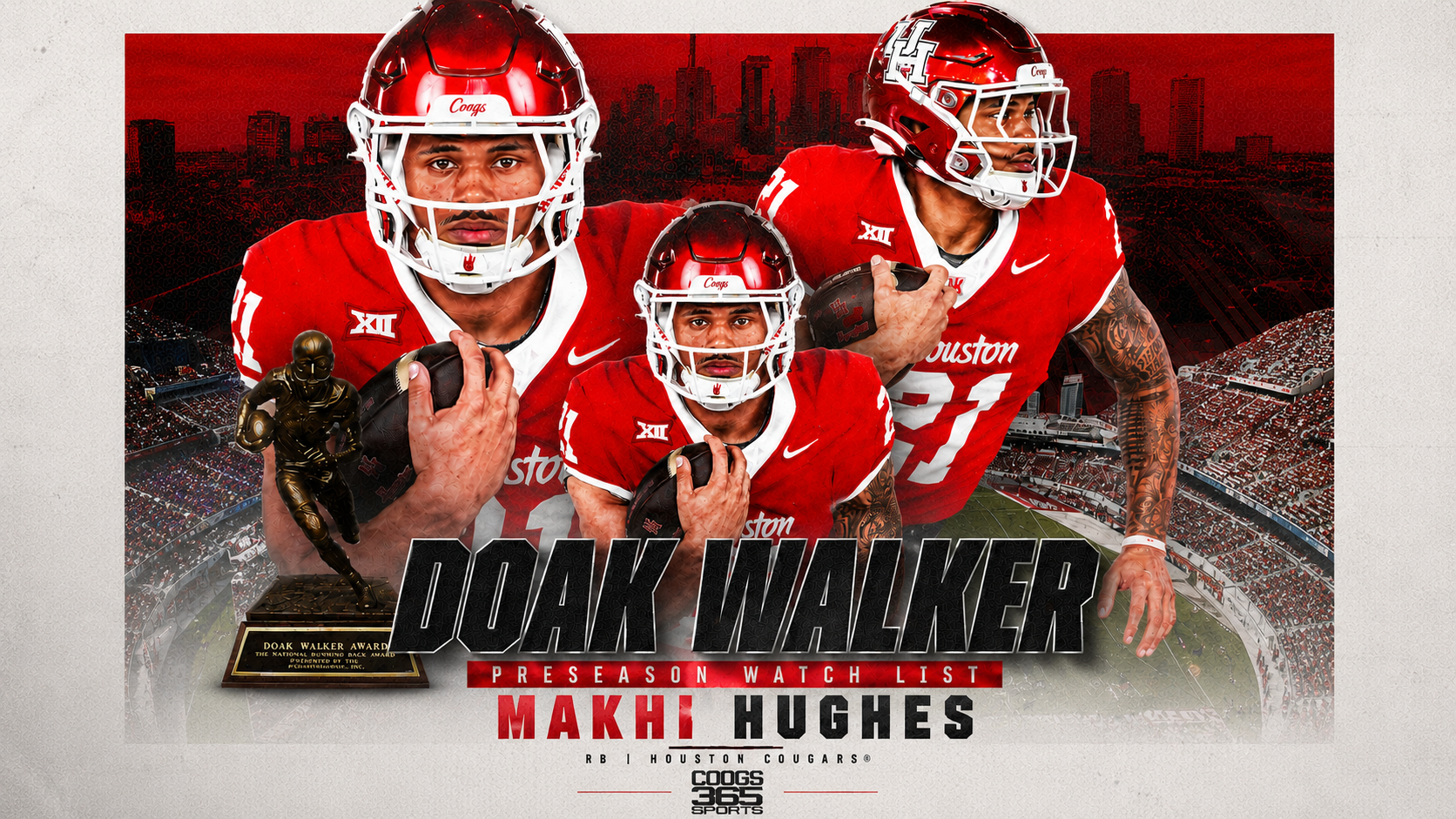
Tuesday,that reunion paid its first dividend. Hughes was named to the preseason watch list for the Doak Walker Award, the trophy handed out every December to the nation's best running back, 62 names deep this year, judged not just on yards and touchdowns but on the sort of character that never shows up in a 40 time. This isn't the first nod for Hughes to the Doak Walker. In 2024, he was named a semifinalist for the award.
It is worth pointing out that the award carries the fingerprints of Hughes's new home state: Doak Walker played his college ball at SMU, three hours up I-45, and the trophy has borne his name since 1990. A Houston running back chasing an honor named for a Dallas legend is the kind of Texas symmetry that writes itself.
Hughes arrives at that symmetry with a resume that reads like a highlight reel translated into a spreadsheet. A 2023 freshman All-American who broke out as a redshirt after missing the 2022 season with an injury. A two-time All-AAC first-teamer. In 2024, he rushed for 1,401 yards, second in the American, tenth in the country, and the fourth-most in a single season in Tulane history, a school that has been fielding football teams since William Howard Taft was in office.
The year before, it was 1,378 yards and seven touchdowns as the redshirt freshman who helped deliver Tulane a conference championship. He was the American's Rookie of the Year in 2024 and, by his own admission in his Houston bio, still counts that freshman All-American nod as the proudest accomplishment of his career ahead of any of the yardage totals.
None of that is why he is interesting, exactly. Plenty of backs put up gaudy numbers in the American and never make anyone in a power conference blink. What makes Hughes worth writing about is the shape of him: 6-foot, 210 pounds, built low and dense, a back who wins with contact balance and vision rather than any single gear of breakaway speed, though he has enough of that too; 267 career receiving yards at better than eight yards a catch suggest a back defenses can't simply key on between the tackles.
He named Walter Payton as his childhood sports hero, which is either a coincidence or the tidiest possible description of how he runs: low pads, quick feet, and a stiff arm that turns arm tackles into missed ones. Oregon never found out what that version of Hughes could do behind a Big Ten offensive line: four games, 17 carries, a redshirt request in October, and a transfer portal entry by January. Houston is betting the answer is worth finding out.
That bet is not blind faith. It is roster construction. Fritz, who has quietly built Houston into a 10-win outfit in two seasons—capped by a 38-35 bowl win over LSU in December—has made no secret that he wants an offense built on tempo control and physicality rather than the run-and-shoot aesthetic the school made famous a generation ago.
He needed a bell cow to replace Dean Connors, last year's leading rusher, and he needed one who could handle the sort of workload of 540 career carries that convinces a coaching staff a back won't wilt in November. He also rebuilt the line in front of him almost entirely through the portal: Shadre Hurst, a Tulane transfer himself, now on the Lombardi Award watch list; Alvin Ebosele, a 6-foot-6, 300-plus-pound tackle out of Baylor; and Drew Terrill from Toledo. One Big 12 assistant coach, sizing up Houston for Athlon's preseason preview, put it about as plainly as a rival coach ever will: getting Hughes, he said, will help.
It should. Quarterback Conner Weigman, who threw for 2,705 yards and ran for another 700 last season, gives Houston a passing game efficient enough that defenses can't simply load the box and dare Hughes to beat them one-on-one.
Wide receivers Amare Thomas and Trent Walker give Weigman someone to throw to when they don't. What the offense lacked last year and lost when Connors graduated was a runner who could turn a Fritz-designed dive into eight yards on third-and-two without anyone in Houston holding their breath. That is the job Hughes was built for in Birmingham and reinforced in New Orleans before a one-year detour to Eugene reminded everyone, Hughes included, exactly how much he was worth.
The Doak Walker race itself will sort itself out over the fall, the way these things do—a National Selection Committee stocked with past winners, former All-Pros, and college All-Americans will trim the list to finalists in late November, cast a second ballot in December, and hand out the actual hardware on the Home Depot College Football Awards broadcast on December 10. Hughes has been through this exercise before; he was a Doak Walker semifinalist as a sophomore at Tulane before the road got complicated.
Whether he is standing on that stage in December depends on several thousand more carries and on a Houston offensive line that has to prove itself in the Big 12. But the watch list was never meant to predict December. It is meant to denote a résumé worth watching, and by that standard alone, Monday got it right. Makhi Hughes has already run out of new addresses. All that's left now is the running.