

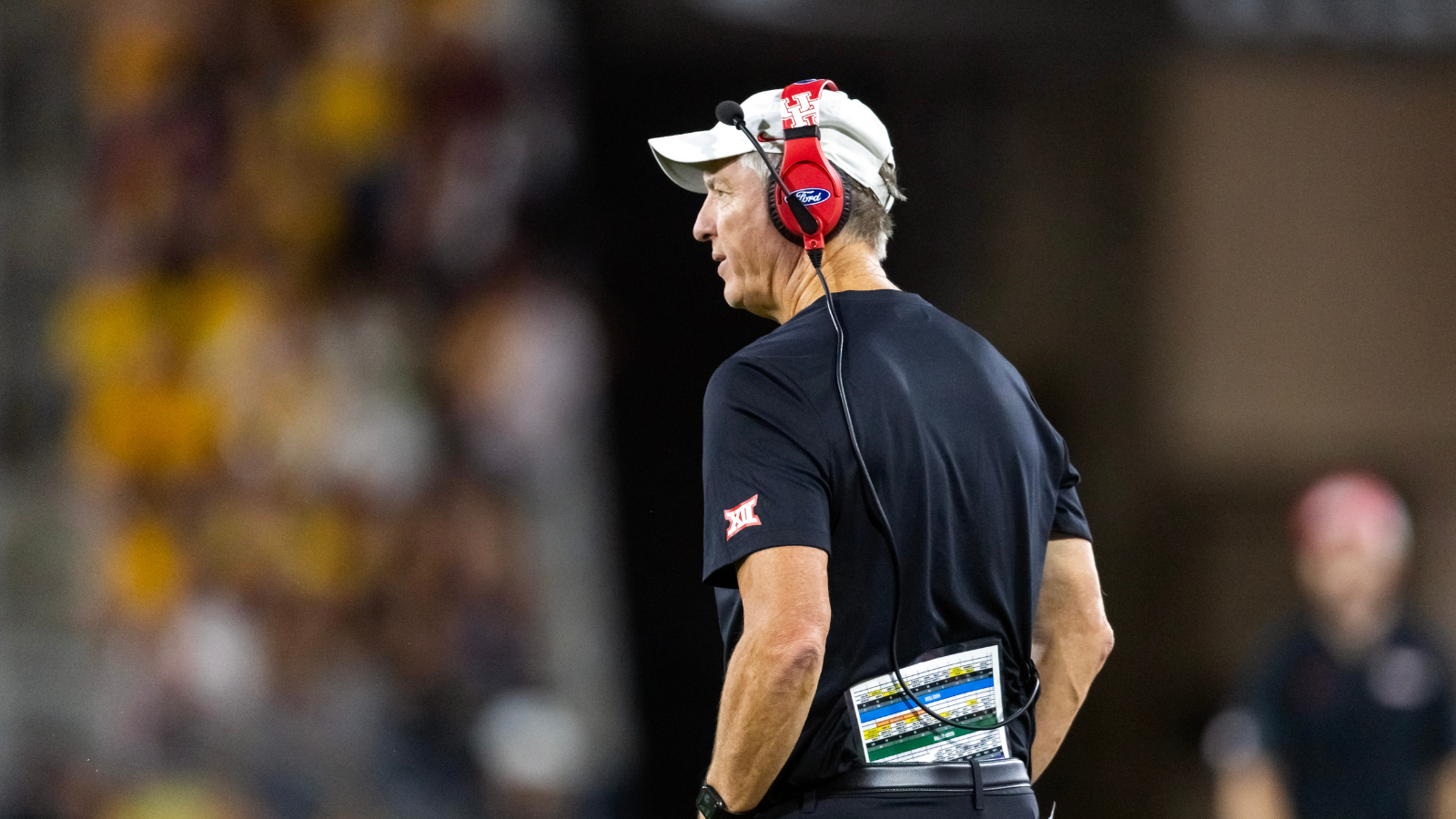
You don't need a crystal ball. You never did. What you need is a calendar, a box score from last November, and the stomach to say the quiet part out loud before the season does it for you.
Here is the quiet part: Houston is good. Houston might even be good enough. The Cougars are three years into life in the Big 12, and they've finally stopped looking like a transfer student trying to find the cafeteria. Ten wins in 2025, a Texas Bowl beatdown of LSU played out in front of a home crowd wearing more red than a Titleist tour bag, and a quarterback in Conner Weigman who had the good sense and the good agent to stick around instead of testing the portal or the draft. Weigman threw for 2,705 yards and ran for 700 more last fall, which is the kind of two-way production that makes offensive coordinators sleep like babies.
Around him, Willie Fritz went shopping like a man who knew exactly what he needed: Makhi Hughes in the backfield after nearly 2,800 rushing yards at Tulane; Trent Walker and Patrick Overmyer to stretch the field; and Amare Thomas already proven as a matchup nightmare in the slot. On paper, this offense doesn't have a hole in it. It has upgrades.
So why does a program that just posted double-digit wins for the first time in its history feel like it's holding its breath?
Because paper doesn't tackle anybody. And Houston's real season, the one that decides whether this is a Big 12 title run or another respectable near-miss, will be fought in a phone booth, not on a stat sheet.
Start up front, on offense, where Fritz is essentially building a new line mid-flight. Left tackle Alvin Ebosele is the lone returning fixture, joined by a rebuilt interior of transfers: Toledo's Anthony Boswell at center, Tulane's Shadre Hurst at guard, and Maryland's Drew Terrill trying to lock down right tackle.
Good pieces, individually. But offensive lines aren't built from good pieces; they're built from repetitions, and this group has a matter of weeks to develop the kind of shorthand that usually takes a full season to earn. Ask Weigman to hold the ball an extra half-second behind a line still learning each other's names, against Big 12 fronts that get paid to make quarterbacks uncomfortable, and see how sunny that offensive outlook still looks in October.
Then flip to the other side of the ball, where the problem isn't projection; it's precedent. Houston's defense didn't lose games last year because it couldn't cover. It lost because it couldn't finish. The Cougars managed all of three sacks over their final four games of the regular season. They haven't cracked 70 tackles for loss in a season since before they joined this league, and last year's front averaged an anemic 4.7 per game.
When Texas Tech and West Virginia hung shootout numbers on Houston, the two losses that kept a special season from being a magical one, it wasn't a coverage bust. It was a defensive front that couldn't get off the field on third down and couldn't hold the point of attack, surrendering 200-plus rushing yards in both games.
The portal additions up front, Oregon's Ashton Porter and Oklahoma State's De'Marion Thomas, are talented. Whether they turn pressure into sacks and stalemates into tackles for loss is the single biggest swing variable on this roster.
The schedule has a long memory. Houston's 2026 slate is a gift and a gauntlet in the same envelope: no Arizona, no BYU, no TCU, no Kansas; all the softer landings are scrubbed from the calendar. But what's left is six true road games in nine Big 12 dates, front-loaded with a trip to Texas Tech, a climb to Utah, a swing through Kansas State, and then, just when legs get heavy and the weather turns, back-to-back road trips to close at Colorado and West Virginia.
Vegas and the beat writers both like Houston, somewhere in the third-to-fifth range of the conference, which is another way of saying nobody's fully convinced, either. The single game that decides whether this team belongs in the room where the trophy gets handed out is October 10 at Kansas State, a game that will tell you everything about whether the new offensive line has jelled and whether that defensive front has learned how to finish what it starts.
So no, you don't need a crystal ball to see Houston's season coming. You just need to watch the six inches in front of the football. If the new linemen protect Weigman's blind side and Fritz's transfer front-seven finally turns pressure into production, the Cougars have the offense and the schedule to make a real run at the Ship. If they don't, this becomes a very familiar story: a talented team that lost the games in the trenches and, with them, the season.
The crystal ball was never the point. The line of scrimmage always was.


