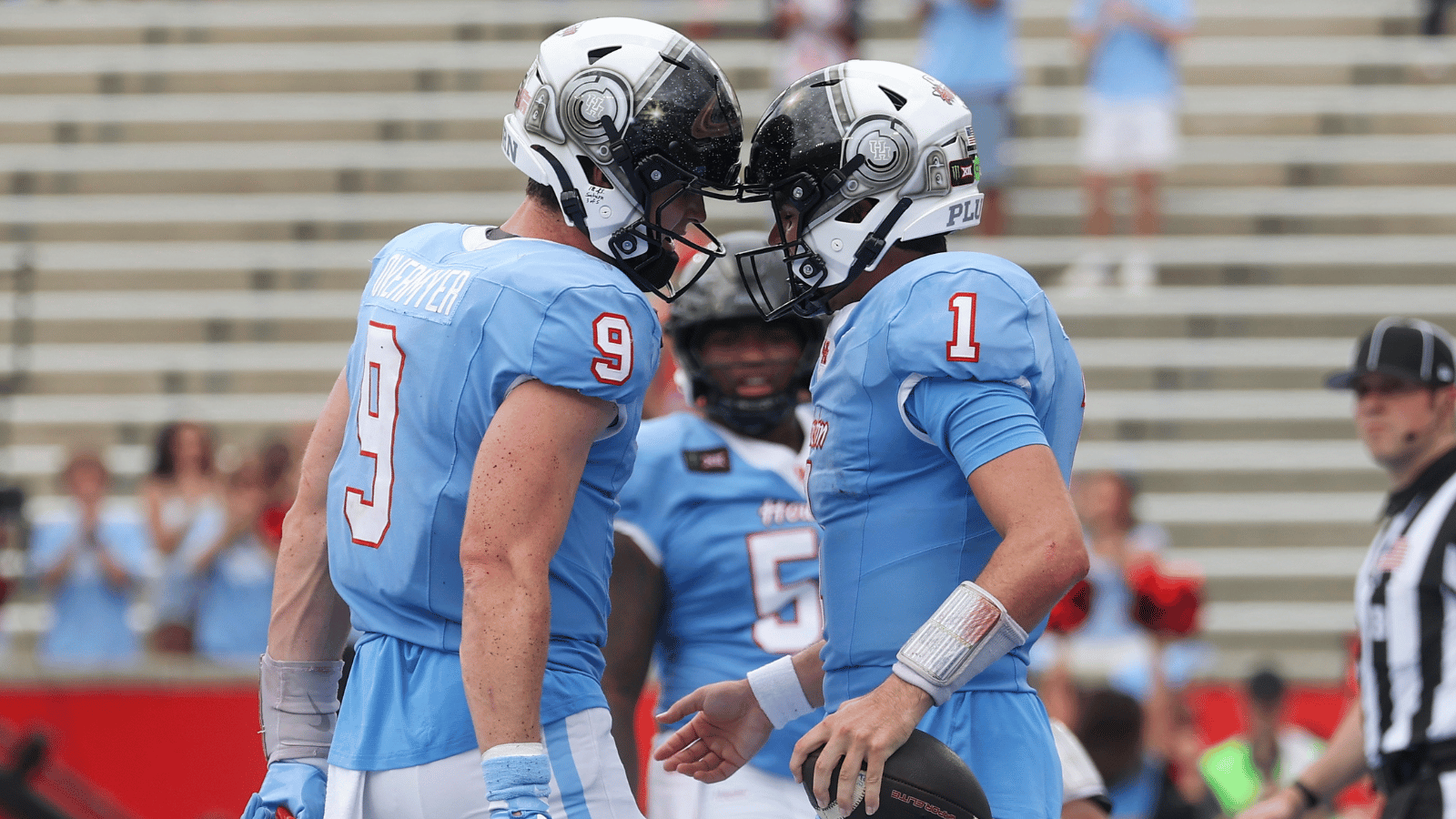


There are ghosts around every football camp in August. Ghosts of the season before. Ghosts of the games that got away. Ghosts of players who once occupied a locker, caught a pass, cracked a joke in the meeting room, and then, because the calendar and rule book said so, moved on. So when a familiar figure appeared at Houston’s practice Monday morning, you could have been forgiven for rubbing your eyes. But this was no ghost. The Boogie Man had returned.
Stephon “Boogie” Johnson, the Houston wide receiver whose college career appeared finished months ago, was back in Cougar gear Monday, beginning the hurried process of turning what had become a legal possibility into a football reality.
And because this is college athletics in 2026, even Willie Fritz sounded reluctant to use a word as dangerous as certain.
“I didn’t want to do anything until I was certain,” Fritz said Monday . “This day and age, I’m not sure what certain is.”
There may be no better sentence to describe modern college football. Not the transfer portal. Not NIL. Not revenue sharing. Not eligibility. Not even goodbye. Especially goodbye.
Johnson was cleared to rejoin Houston and participated in Monday’s practice, with the program now eligible to play this fall. The road that brought him back makes it something else entirely. Johnson seemingly exhausted his eligibility after last season, when a Lisfranc injury in his right foot interrupted what had been developing into an important year. He appeared in five games — agonizingly close to the participation threshold that might have preserved the season — and later sought a medical redshirt. The NCAA denied it in January. Most thought that his Coog career was over, or so everyone thought.
Johnson had produced 69 receptions for 954 yards and five touchdowns during three seasons at Houston. Before the injury last season, he caught 13 passes for 275 yards and two scores. He had done enough to leave memories. Apparently, he had not done enough to leave.
The door cracked open this summer amid the expanding legal battle over the NCAA’s eligibility structure, particularly for athletes from the high school Class of 2022 who had exhausted their traditional seasons. A July 31 federal injunction opened the possibility of another year for that group. Then, because college athletics now changes direction about as often as a slot receiver against man coverage, the 10th Circuit Court of Appeals paused that class-wide order Friday, Aug. 21.
The broader fight remains unresolved. Three days later, Johnson was standing on Houston’s practice field. Which brings us back to Fritz. “This day and age, I’m not sure what certain is.” That was not a punch line. It was practically a mission statement for college football in 2026. The sport spent a century writing its rules in ink. Now they might as well come on an Etch A Sketch. Shake vigorously. Begin again.
Fritz understood the uncertainty, which is why he deliberately kept his distance while Johnson’s situation worked its way through the machinery.
“I kind of stayed out of it while we were doing all this,” Fritz said, “because I didn’t want to give him big-time hope and I didn’t know what was going to happen.”
There is something unusually humane buried inside that answer. Coaches sell hope for a living. They sell it to recruits and boosters, in living rooms and at podiums, and every August when everybody is undefeated and every problem can theoretically still be solved before kickoff. But Fritz would not sell Johnson hope he could not guarantee. So Johnson waited. Houston waited. The lawyers argued. The rules shifted. Football kept getting closer. Then Monday came.
“Today,” Fritz said when asked when Johnson officially started back with the team. After months of uncertainty, one wonderfully uncomplicated word. Today. There is plenty of work hidden inside it. Johnson cannot simply emerge from the mist, buckle his chinstrap, and line up on the first snap against Oregon State. He must complete helmet acclimation work before fully returning to action. He missed spring practice and nearly all of fall camp. Fritz estimates him to be roughly nine months behind teammates who have spent that time living inside this version of Houston’s offense. The advantage is that Johnson is not arriving in a foreign country. The offense is essentially the same. The coaches are largely the same. The language is familiar, even if some of the vocabulary has changed.
“The great thing about it is we’re running the same offense,” Fritz said. “Basically, he’s got the same coaches.”
Then came the qualification. “It’s not going to be easy for him because he’s nine months behind.”
There are new wrinkles to learn, personnel packages to understand, signals to recognize, and terminology that must be pulled from somewhere in the back of Johnson’s mind and made instinctive again. Football does not allow much time for nostalgia.
The corner does not care that you received another year of eligibility. The safety does not care what a judge decided.
The ball is snapped all the same. Johnson will have to earn his way back into a receiver room that continued moving while his future sat in limbo.
“He’s going to put his time, effort, and energy in and earn his ability to play as much as he, I know, wants to play,” Fritz said. That part, at least, is wonderfully old-fashioned. Nothing in a courtroom gives Johnson a starting job. Nothing in the rule book guarantees him a target. Eligibility gets you through the door, but football decides what happens afterward, and that is where Johnson’s return becomes more interesting than the legal case that enabled it.
Houston does not need him to be a symbol. Houston needs him to be a receiver. A good one. When healthy, Johnson has already shown he can be that. He knows how to uncover. He understands the speed of Big 12 football. He has lived through Saturdays when windows close faster than expected and one missed step can turn a completion into third-and-long.
There is value in having been there before. There is even more value in getting another chance to go there again, particularly for a Houston team moving quickly toward Sept. 5 and its opener against Oregon State.
Most August additions arrive carrying luggage. A transfer needs the playbook. A freshman needs to adjust to the speed of the game. A late arrival needs introductions. Johnson already knows where everything is. He knows the coaches, the building, and the expectations. Most importantly, they know him.
“We know him,” Fritz said. “That’s the difference between adding somebody that you don’t know.”
Three words worth remembering. We know him. That matters inside a locker room. Players notice when somebody is parachuted onto a roster late. They understand opportunity, but they also understand equity. They know who went through winter workouts, who ran in June, and who endured August in Houston when the heat presses down like another shoulder pad.
Johnson cannot claim those months, but he also does not arrive as a stranger asking everyone to make room. Several teammates approached him Monday and welcomed him back. There are transactions and then there are reunions.
This felt like the latter. Perhaps that is why Monday carried a little more poetry than most late-camp practices.
Football is forever telling players when something is over: the last high school game, the last home game, Senior Day, and the final snap. Clean out your locker. Thank you. Good luck. Johnson received his ending in January when the NCAA denied his medical redshirt request. He had been only two quarters beyond the participation limit. There are crueler measurements in life, certainly, but few feel quite as arbitrary to a football player as watching months of work reduced to a handful of plays on a compliance form. Then summer arrived. The law moved. The ground shifted. A door that had been locked suddenly stood open. Now there is another helmet, another practice, another route. Maybe another touchdown.
Nobody knows exactly where the eligibility battles consuming college sports eventually lead. Friday’s appeals-court ruling made that plain. There will be more lawsuits, more orders, more appeals, and probably more mornings when coaches check with compliance staff before checking the depth chart.
Fritz knows better than to pretend otherwise.
He was asked Monday whether he finally had enough confirmation to feel comfortable. “Yeah,” he said, before catching himself in the reality of the age. “But how everything changes … I feel great about it, but things are a little different nowadays.”
Indeed they are. Once upon a time, the strangest thing you might see at an August football practice was a trick formation.
Now a young man whose college career appeared finished in January can walk back onto a practice field in August, fasten a Houston helmet, and start again.
No séance required.
No apparition.
No ghost.
Just the "Boogie Man," healthy again, chasing the months he lost and whatever might still remain on the other side of them.
Willie Fritz can worry about the football terminology. The lawyers can worry about terminology of another kind.
Johnson’s assignment is considerably simpler. Run. Separate. Catch the football and perhaps savor the peculiar gift contained in every snap, because few players are ever permitted to hear the final whistle on one chapter of their lives and then, months later, discover somebody has put time back on the clock. Monday morning, Houston wasn’t seeing a ghost. The Boogie Man had come back. And in this strange new college football world where almost nothing is certain, that was certain enough.