
Sit in a scouting chair long enough and you learn to distrust a cornerback's tape until the ball is actually in the air. Anybody can run a route in phase for four seconds. The evaluation starts at the fifth, when the receiver's break forces a decision and the corner either flips his hips clean or gives up half a step trying. That's where you find out what you actually have. On Houston's tape, what you have at No. 5 is a player whose eyes and hands function on a delay so short it looks like anticipation rather than reaction.
That's the trait that shows up first watching Will James, and it's the trait a program builds a scheme around: he doesn't just survive the route; he closes on it. Twice against TCU last November, in the same game, a ball came out of the quarterback's hand into what should have been a window and wasn't—James got there before it did, a career high, adding a forced fumble in the same outing that tied his own mark for tackles. The Big 12 named him its Defensive Player of the Week. PFF put him on its national honor roll. Watch the tape, and neither is surprising; the ball skills are the loudest thing on the field.
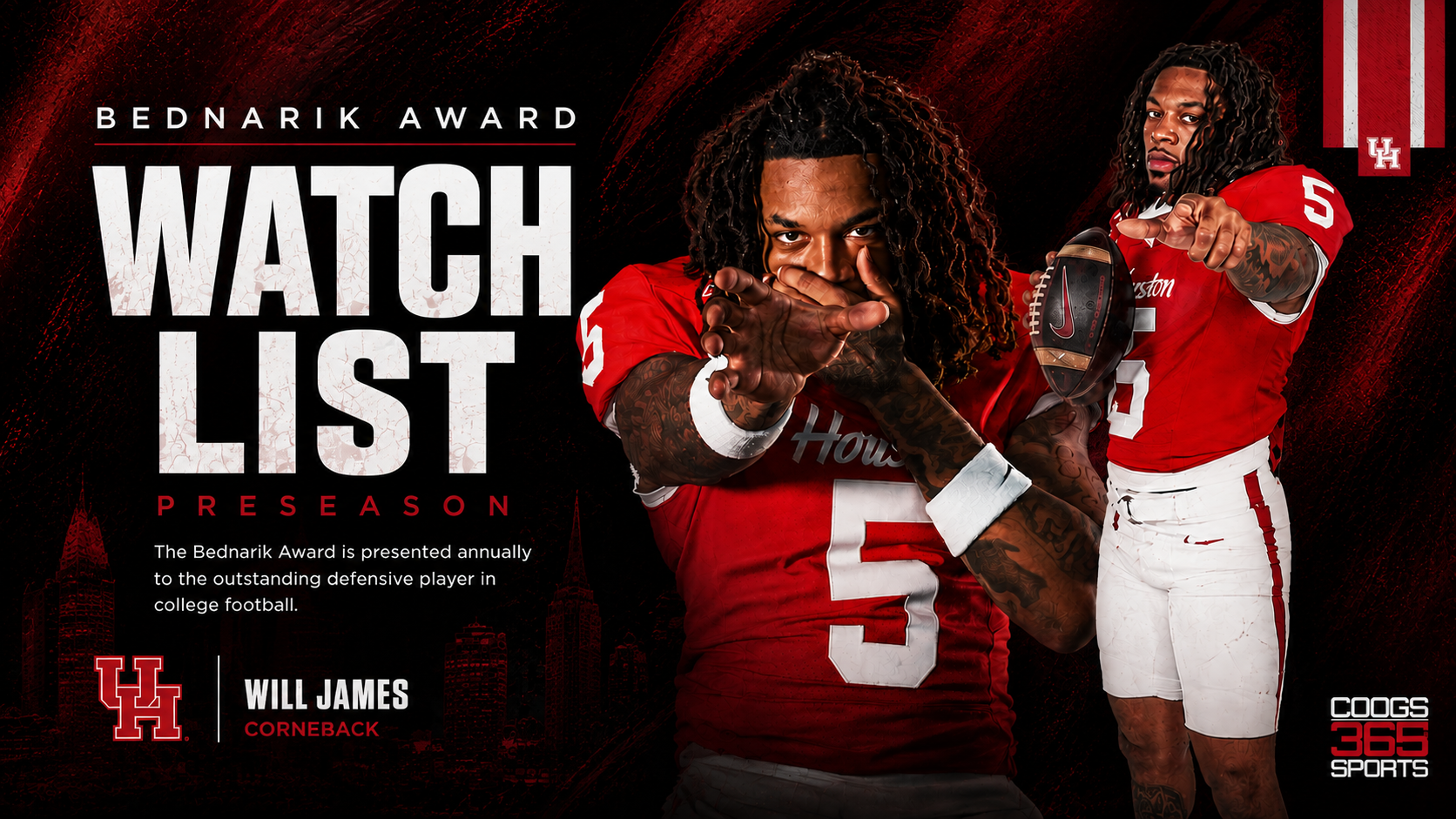
Houston made that trait official business on Friday, as the Maxwell Football Club added James to the Chuck Bednarik Award watch list, the preseason marker for the country's top defensive player, on the heels of a Panini Senior Bowl Top 300 nod and a spot on the Bronco Nagurski watch list. Preseason recognition is a projection, not a verdict, but it's the kind of projection that tracks with what personnel departments actually value in a slot or boundary corner: not just coverage competence, but a demonstrated, repeatable ability to finish the play with the ball in his own hands.
The 2025 tape backs the projection with volume. James led Houston in interceptions (3), total takeaways (4), and forced fumbles (2); added eight pass breakups—second on the roster; and posted a 77.8 PFF defensive grade, third among Houston defenders. Those are ball-production numbers a program circles independently of the scheme because they measure something the scheme can't manufacture: instinct in phase, the split-second read that turns a contested catch into a turnover. His second career start, at Rice, is the tape cut you'd show to illustrate it—a tipped pass, a corner who didn't hesitate on a loose ball, and 37 yards the other way for a touchdown that kept the Bayou Bucket in Houston's building.
Two other traits matter as much as the ball skills, and both show up away from the highlight package. The first is competitive toughness—the willingness to trigger downhill and finish as a tackler, not just a coverage piece, which the forced-fumble total and the multiple-tackle games suggest is not a hole in his profile.
The second is football IQ, the harder trait to grade because it doesn't announce itself: it's the corner who's already diagnosing route combinations before the snap, and it tends to be the difference between a player who's good as a sophomore and a player who's still improving as a senior. James profiles as the second kind.
He started all 13 games in Year One at Houston after already logging extensive reps at both outside spots during stops at Southern Miss and Mississippi State — a body of tape spanning three programs and both boundary and field alignments, which is exactly the kind of positional versatility programs prize when they're trying to project a corner's coverage flexibility rather than guess at it.
Ask James himself about the room around him, and the evaluation starts to sound less like a scouting report and more like an internal status update. "I most definitely feel good about the longevity thing and availability with our staff as far as DBs," James said. "We're trying to get back healthy... but fall, we're slowly getting better and slowly recovering faster and faster." It's a small answer, but it treats health as its own trait—unglamorous, easy to overlook, and foundational since none of the ball production or coverage instinct matters if the room can't stay on the field together.
The payoff for solving that health question is scheme-specific, and James was precise about what it buys Houston. "Playing with depth, you most definitely win a lot more games, and you can most definitely play a lot more man calls," he said. "When you have less depth, players get tired, and you kind of weaken up."
That's a corner talking like a coordinator: depth is what lets a staff live in man coverage, the calls that lean hardest on exactly the traits—the closing speed, the ball skills, and the recovery—that make James dangerous in the first place. A thin room forces a zone. A deep one hands the ball back to players built to take it.
Houston cornerbacks coach Marcus Trice doesn't hedge when the subject is James. "He is a really good player," he said. "I think he's one of the best in the country." The next sentence is the one that matters more, though: "There's still a lot of room for improvement." James, credit to him, agrees with his coach more than his clippings. Trice calls him a player "pressing forward," hunting the small technical flaws that separate very good corners from the ones who win trophies.
The background supports the evaluation rather than decorating it. James is a Grand Bay, Alabama, product who redshirted at Mississippi State, led Southern Miss in passes defended as a true freshman, and then transferred into a starting role at Houston immediately—a track record of production regardless of program or system.
None of that guarantees an award in December, and preseason grades have a way of getting revised by October. But the traits that matter most in this evaluation—ball production, competitive toughness, and positional IQ—are already on tape in volume, not projection. Houston isn't hoping James becomes a weapon in its secondary. From the tape to fall camp observation, it says he already is one.