

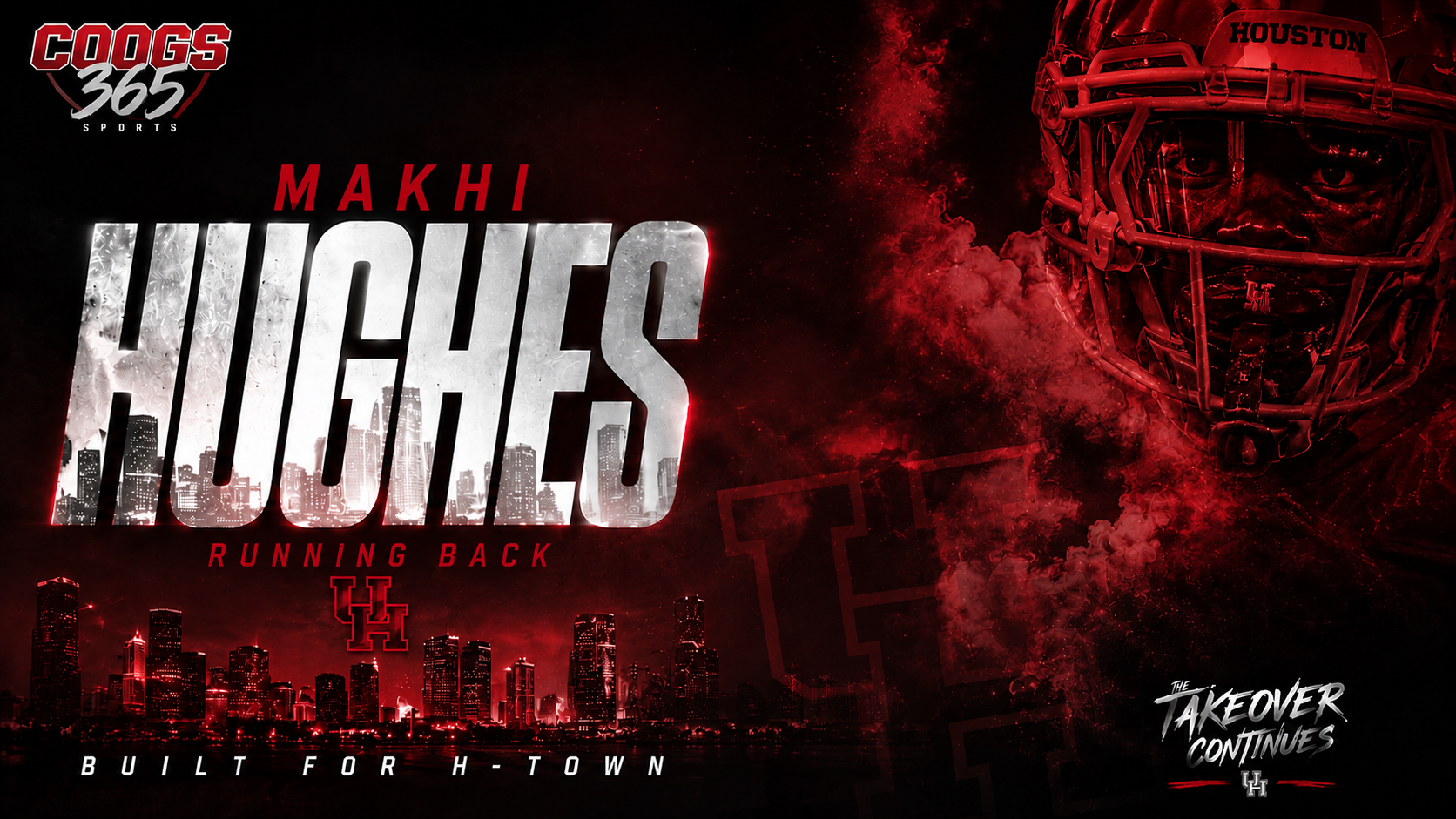
Championships are not won on the back of one athlete. They aren't carried by a single quarterback, running back, or even a handful of stars. Football demands too much coordination, depth, and sacrifice for that, but championships can be shaped by having the right players in the right places. That's why Makhi Hughes matters.
Houston didn't simply need another running back. It needed a runner who could change how opponents defend the entire offense. Hughes can be that player.
There will be explosive passing moments at TDECU Stadium this season; Conner Weigman will make sure of it. He has the arm talent to attack vertically, the athleticism to escape pressure, and the confidence to turn a broken play into a defensive crisis. Houston has every reason to believe its passing game can produce fireworks.
The challenge is making sure defenses can't spend every snap waiting for them. That's where Hughes enters the equation. A dangerous passing attack becomes far more difficult to contain when the defense must also respect a physical, dependable running game. Safeties can't drift back as quickly. Linebackers can't immediately vacate the box. Defensive ends can't charge recklessly upfield.
Every defender must pause, and in modern football, that moment of hesitation can be the difference between a modest gain and a touchdown. Hughes gives Houston the ability to create it.
A Career That Never Followed the Easy Route
Hughes' college career hasn't been conventional, and that's part of what separates him.
At Tulane, he developed from an overlooked prospect into one of the most productive running backs in the country, establishing himself over consecutive seasons as a workhorse who could carry an offense, absorb contact, and stay effective deep into games. He didn't build that reputation through one spectacular afternoon; he built it through volume.
Carry after carry. Drive after drive. Saturday after Saturday.
Then came Oregon. Hughes arrived in Eugene with an established résumé and real expectations, but his role never developed; opportunities were limited, touches were scarce, and his momentum stalled.
Some will view that season as a warning. Houston should view it as fuel. A quiet year doesn't erase the vision, balance, and toughness that made Hughes successful; a back doesn't consistently produce, survive heavy workloads, and punish defenses over multiple seasons without possessing something real. The Oregon chapter may have slowed his rise. It didn't redefine him.
Now he arrives in Houston with something to prove and a staff that already knows what he can become. Willie Fritz understands his temperament. Slade Nagle knows how to feature his skill set. Hughes knows the physical identity those coaches demand.
This isn't an introduction. It's a reunion with purpose.
The Value Beyond the Highlight Run
Running backs are often judged by speed. Can he reach the edge, outrun a safety, and turn a crease into a 70-yard touchdown? Hughes can produce those plays, but his greatest value may be in the runs that never make a highlight reel: the ones where the blocking breaks down, where a linebacker fills the correct gap, where the defense wins the initial collision but still can't finish the play.
That's where Hughes changes an offense. He runs with patience but not passivity, allowing blocks to develop, forcing defenders to reveal their leverage, and then attacking the space they surrender. His vision creates opportunities, his balance extends them, and his physicality finishes them. Hughes doesn't treat first contact as the end of a run; he treats it as another obstacle.
That distinction matters. A back who turns a two-yard gain into five protects the offensive line. A back who consistently falls forward protects the play-caller. A back who keeps the offense out of third-and-long protects the quarterback. Those yards may never dominate a highlight reel, but they determine possession, field position, and eventually the outcome. That's offensive infrastructure, and Hughes can provide it.
The Conflict Houston Wants to Create
The best offenses don't merely execute plays; they force defenders into impossible decisions. Place Hughes beside Weigman in the shotgun, and the defense already has a problem. Add a defender to the box, and Houston can attack isolated coverage outside. Spread out to defend the pass, and Hughes gets favorable running lanes. Crash toward the running back, and Weigman keeps the ball. Hesitate on the mesh point, and Hughes is already pressing downhill.
Every answer creates another question. That's the conflict Nagle wants to manufacture, and Hughes makes it possible. Defenses must respect him as a legitimate between-the-tackles threat rather than assume the first tackler will bring him down. Against Hughes, that first defender may only slow the play; a second may be needed to finish it.
That extra attention opens space elsewhere: throwing lanes behind linebackers, one-on-one matchups for receivers, stronger play-action, and run-pass options that are harder to diagnose. Hughes doesn't have to touch the ball to affect the defense. His presence can change alignments before the snap. His reputation can change reactions after it.
The Back Who Keeps the Machine Moving
Explosive plays will always command attention. A deep completion produces the roar, a quarterback scramble brings the crowd to its feet, and a receiver pulling away in the secondary becomes the image replayed all week. But offenses don't survive on electricity alone.
They need rhythm: dependable production on first down, conversions in short yardage, and control of the ball when the other offense starts finding momentum. They need someone who can turn chaos into manageable situations.
Hughes can be that stabilizing force. He doesn't need 30 carries a week to influence the game. Houston just needs opponents to believe he could get 30. That threat changes how a defense prepares, how a coordinator calls the game, and how defenders feel in the fourth quarter. A physical running game has a cumulative cost: every tackle gets heavier, every block lingers a little longer, every possession takes a bit more out of the defense. By November, that cost matters.
The Big 12 can turn into a weekly exchange of explosive plays, where one empty possession becomes a two-score deficit before an offense can recover. Hughes gives Houston another way to win: punishing lighter fronts when the passing game is rolling, restoring order when it stalls, and closing out games when Houston is protecting a fourth-quarter lead. That versatility is what separates a useful running back from a difference maker.
More Than a Redemption Story
It would be easy to frame this season as Hughes' redemption tour, but that undersells what's at stake. Yes, he has something to prove after Oregon. He has to show the runner who dominated at Tulane is still intact and that his game translates against the speed and physicality of the Big 12. But Houston doesn't need Hughes chasing the player he used to be. It needs him applying everything his journey has taught him.
He knows what it's like to be overlooked. He knows what it's like to become the centerpiece of an offense. And he knows what it's like to enter a program with major expectations and watch his role disappear. Those experiences can break confidence; they can also sharpen it. Hughes arrives in Houston carrying both perspective and urgency, understanding that opportunity is never guaranteed, even for a player with proven production. This season isn't just another chance. It's a chance to remind the country what kind of runner he is.
Houston's Potential Difference-Maker
Houston is no longer interested in merely proving it belongs in the Big 12; the next step is becoming a factor in the conference race. That requires more than talent; it requires players whose presence improves everyone around them. Hughes has the ability to be one of those players.
Weigman can produce the spectacular. Houston's receivers can stretch the field. Nagle can design the matchups.
But Hughes can create the balance that makes the whole system more dangerous, forcing safeties forward, slowing down pass rushers, keeping linebackers trapped between responsibilities, turning second-and-long into third-and-manageable, and third-and-short into another chance to strike.
Championships will never rest on one athlete's shoulders. But the right athlete can make the weight easier for everyone else to carry.
There will be fireworks at TDECU Stadium this season. Weigman will attack downfield, receivers will find space, and Houston will have moments when the offense looks fast, modern, and explosive. But beneath that electricity, the Cougars will need something more elemental: the collision of shoulder pads, hard-earned yards, second efforts, and a running back who makes a defense feel every possession.
Makhi Hughes has traveled an unconventional road to Houston. Now, reunited with coaches who understand his game and positioned inside an offense built to benefit from his presence, he has a chance to become more than the Cougars' featured back. He can become the force that makes everything else go.


