

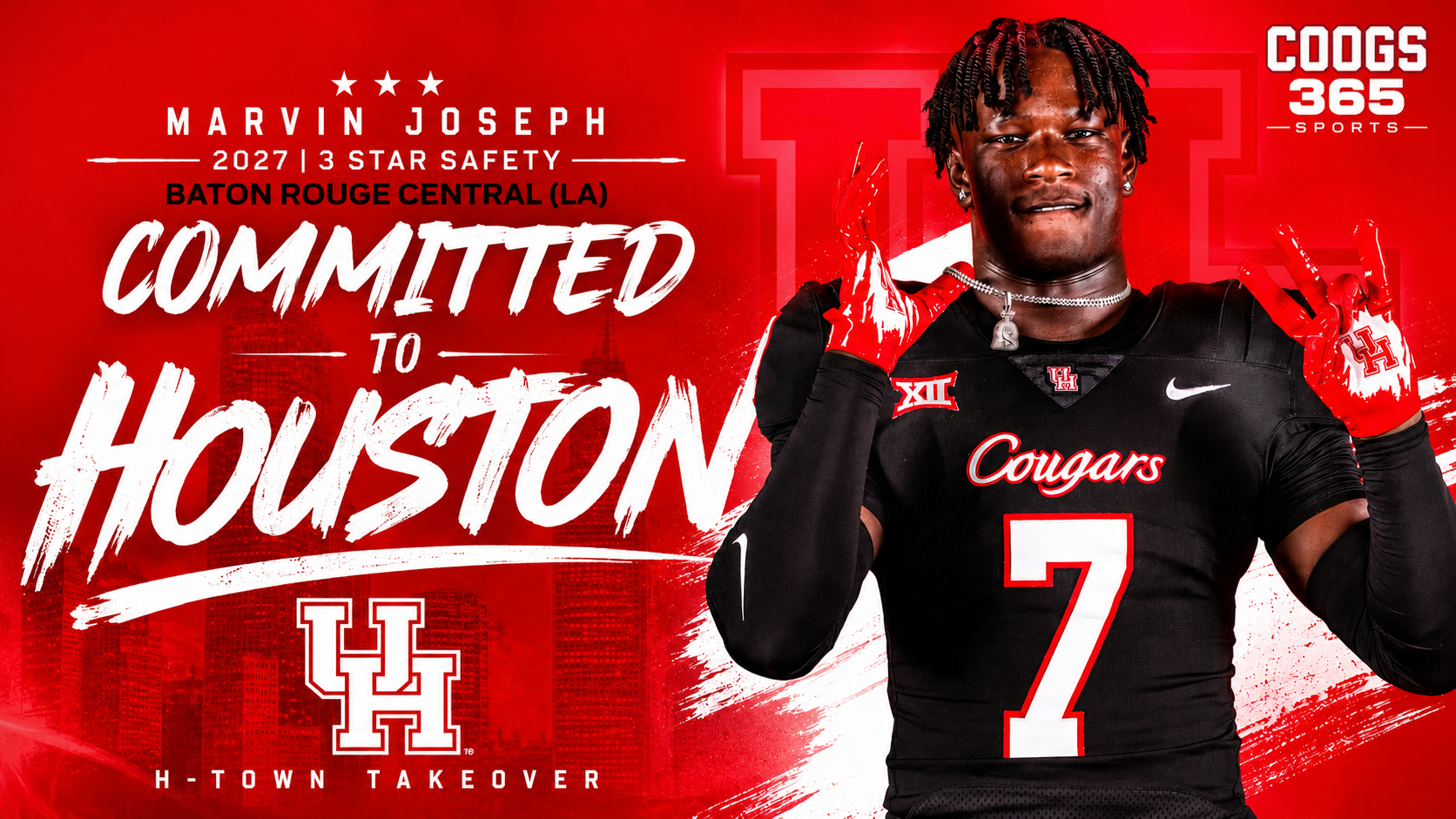
There is an old, stubborn truth in this business that keeps getting rediscovered every recruiting cycle as if it were new: the best pitch is rarely the loudest one. It's the one that shows up. On a Wednesday afternoon in Baton Rouge, with two other programs still waiting by the phone, Marvin Joseph a 6-foot safety out of Baton Rouge Central who plays the position like it owes him money, picked up a Houston hat instead of a Kansas State or Arkansas State one, and in doing so handed Willie Fritz's program something it has needed all summer: proof that the plan works.
This is the part of the story that gets told every year and somehow never gets old the kitchen-table visit, the coach who drove down instead of just calling, and the family that noticed. But strip away the sentiment for a second, because this commitment deserves more than a nice story. It deserves film study. Marvin Joseph isn't just a name Houston needed to add to a spreadsheet to quiet the message boards. He's a specific kind of player walking into a specific kind of scheme, and the fit is close to ideal.
The Player: A Safety Built for Conflict
Ranked as the No. 79 overall safety nationally in the 2027 class, Joseph won't turn heads on a recruiting service's star chart, and that's precisely the point: the ratings measure workout numbers and highlight reels; they don't measure what a safety actually has to do on Saturdays, which is live in conflict. Run support, force fits, matching tight ends up the seam, reading a quarterback's eyes before the ball comes out—and that's a job description built for discomfort, and it's a job Joseph has said, in his own words, that he wants no shortcuts to.
He wants to compete for it. That's not a throwaway quote. For a position that lives or dies on instinct and want-to, a prospect who says he doesn't want anything handed to him is telling you something about how he'll practice, not just how he'll play.
At 6-foot, he has the frame to play in the box as a de facto extra linebacker on early downs, then bump out to split-field coverage on third down the modern safety's dual mandate. Programs that ask one safety to do everything are increasingly rare; the ones that thrive ask their safeties to do different things depending on down, distance, and personnel.
That kind of positional flexibility only works if the player himself is flexible, comfortable being wrong in a run fit on Tuesday and coached hard for it, comfortable adjusting a leverage point on Wednesday because the coordinator changed the coverage shell. Everything about how Joseph has described what he wants out of program development, trust, and competition suggests a kid who's built for that kind of week-to-week coaching, not allergic to it.
The Scheme: Where He Actually Fits
Here's where the analysis gets specific, because "safety" is not one job anymore it's several jobs wearing the same jersey number. Houston, under this defensive staff, has increasingly asked its back end to play fast downhill against the run while still carrying real coverage responsibility in a conference that lives on tempo and spread formations.
That's a demanding ask. It requires a strong safety type who can play with his eyes in the backfield without getting eaten alive by play-action and who has the recovery speed to not get stranded when a slot receiver turns a seam route into a foot race.
Joseph profiles exactly there. He's not a single-high, ball-hawking free safety who wants to sit fifteen yards off the ball and read the quarterback's shoulders all day; that's a different skill set, a different body type, largely a different guy.
He's a competitor who wants to be around the football, which in scouting shorthand usually means a player who's more comfortable at 5-8 yards than 15, a player who'd rather diagnose a screen and blow it up than backpedal into a Cover-3 rotation. Pair that temperament with his size, and you can see exactly why safeties coach PJ Hall targeted him early and stayed on him late. This isn't a projection so much as a plug-and-play fit into a role Houston's defense already asks a safety to hold down.
The Tandem Piece: Why the Timing Matters
Recruiting analysis too often treats each commitment as an island: evaluate the player, file the report, move to the next name. That misses half the story. Joseph doesn't join Houston's class in a vacuum; he joins it as the second safety commitment, alongside Atascocita's Tavon Bolden, and in a defense that plans to play multiple safeties simultaneously in obvious passing situations, that pairing matters as much as either player's individual grade.
Building a safety tandem in the same class isn't just about accumulating talent; it's about accumulating chemistry on a clock. Two defensive backs who learn a system together, who take the same install meetings as true freshmen, who make the same rookie mistakes in the same fall camp, tend to communicate faster once they're actually playing meaningful snaps together two or three years down the line.
Coordinators talk about "reps in the system" as the thing that turns raw talent into a functioning secondary; Houston just bought itself two prospects who'll bank those reps on a parallel timeline. That's not an accident. That's a coaching staff building a room, not just filling a roster.
The Pipeline: Why Louisiana, Why Now
There's also a broader-lens read here, and it's worth sitting with. Baton Rouge sits minutes from Tiger Stadium, which is to say it sits deep inside territory that isn't supposed to be soft ground for anybody but LSU.
Every time Houston pulls a genuine prospect out of that radius, it's not just a roster transaction; it's a message to the rest of the league that the "Bayou 2 Bayou" Pipeline, which the staff has invested in, isn't a marketing phrase; it's a functioning recruiting philosophy with real returns.
You don't win players out of hostile recruiting territory with facilities tours. You win them the way Houston won this one with a coach at the kitchen table, a relationship built over months instead of days, and a pitch that had nothing to do with hype and everything to do with fit.
The Bottom Line
Strip away the hats-on-the-table theater of commitment day, and what's left is a straightforward football evaluation: Houston needed a competitive, downhill-capable safety who could grow into a dual-role back-end piece, and it landed one who happens to already have a running mate in the same class. That's not just a name added to a class ranking. That's two years of scheme-fit projection and program-building philosophy validated by a Joseph who had options but chose the program that showed up first and stayed longest.
Houston still has work to do this cycle; the class ranking says as much. But on a humid Wednesday in Baton Rouge, the Cougars didn't just win a recruitment. They proved the plan works, and in a business built on hope and projection, having actual proof is worth more than any star rating ever will be. Another Bayou 2 Bayou win for the Coogs!
Houston currently sits at No. 61 in the national team rankings for the 2027 class with 13 commitments on the board with Joseph's announcement.