
The numbers alone should have sent Baton Rouge into a panic. Seventy-six catches. One thousand, three hundred and sixty-seven yards. Fifteen touchdowns. An average of nearly 18 yards every single time he touched the football—produced against the best competition 5A Louisiana has to offer.
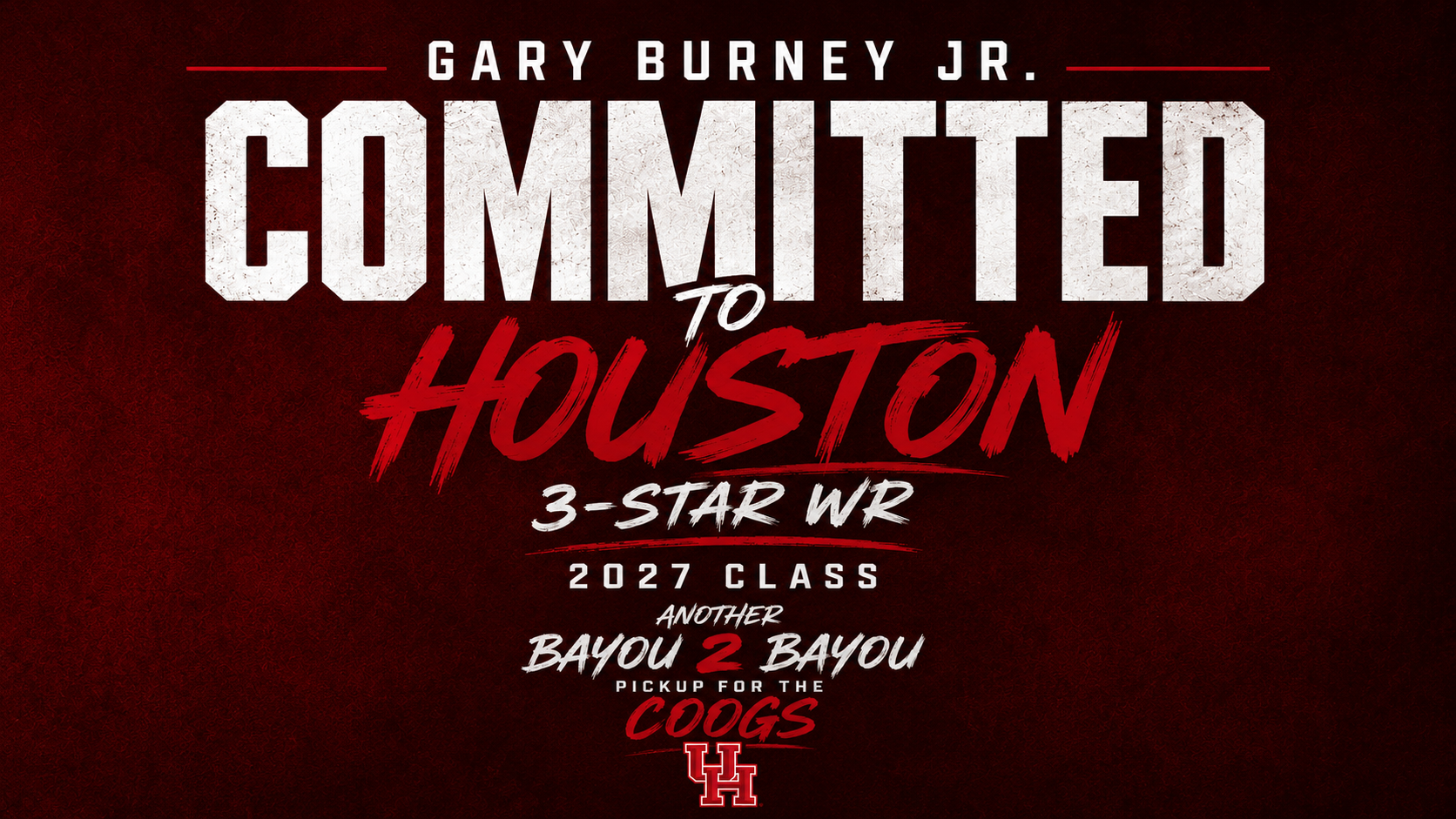
And on Saturday, during an official visit to Houston, Gary Burney Jr. made the most consequential decision of his young life. He chose the Cougars.
Not LSU. Not Tulane. Not Cincinnati. Houston. Call it a coup. Call it a pipeline play. Call it another chapter in Willie Fritz's most compelling recruiting story yet. Whatever you name it, the Bayou 2 Bayou pipeline just landed its most electrifying piece—and the reverberations from Bossier City to the banks of Brays Bayou should be felt for years to come.
What Burney Actually Is—And Why It Matters
Let's start with what the box score doesn't capture: the 6 foot 4, 200 lb Jr. plays football.
Watch his 2025-26 full-season highlights, and you'll see a player who wins at every level of the route tree. He has the long speed to threaten corners vertically, the savvy to manipulate leverage on intermediate routes, and enough burst after the catch to turn a 12-yard dig into a 30-yard gain. Parkway—a program that finished 11-2 in the 2025-26 campaign against legitimate Louisiana competition—didn't manufacture his touches. He earned every one of them.
The 17.99 yards per reception figure isn't a product of padded statistics against weak opposition. This was a centerpiece receiver on a 5A playoff team, and he responded by ranking as the 66th-best wideout nationally in his class. His explosiveness isn't just a speed trait, either. Watch him at the top of the route—there's a suddenness to his breaks, a quick-twitch quality at the stem change that defensive backs at the high school level simply cannot replicate in practice. His releases off the line are varied. He can stack corners on verticals as easily as he sinks his hips and returns to the football on out-routes.
He is a receiver who wins at all three levels of the route tree—with the production to prove it. Landing in Houston's offense is not a story about recruiting. It's a story about trajectory.
At this stage of his development, that's translatable. That's coachable. That is a college production waiting to happen to the right offense—and Houston just may be precisely that.
Beating LSU in Its Own Backyard
Let's not move past what happened here without appropriate context. Gary Burney Jr. is from Bossier City, Louisiana — roughly 50 miles from Tiger Stadium. He grew up watching LSU. He played his junior season in a state where Lane Kiffin's program controls the recruiting agenda. Yet when it came time to commit, he bypassed the home-state SEC powerhouse, bypassed a rising Tulane program, and bypassed Cincinnati to choose a Big 12 school located in Texas.
That does not happen by accident. That happens when a coaching staff makes a prospect feel genuinely seen — not just recruited.
Fritz's pitch to Louisiana prospects has always centered on proximity and path. Houston is roughly four hours from Bossier City. Close enough for family road trips. Far enough for a young man to build his own identity. The Cougars' Big 12 platform offers nationally televised Saturday afternoons, a consistent path to bowl games, and a real shot at College Football Playoff relevance under a head coach who has orchestrated one of the sport's most quietly impressive turnarounds.
But perhaps more than location, Fritz's staff articulated something LSU cannot uniquely offer: a clear, defined role in an offense being constructed specifically around playmakers, with a five-star quarterback already committed and two developing offensive line bookends now locked in as well. Burney isn't arriving to compete for a spot. He's arriving to become the centerpiece.
Why Houston's Offense Was Built for Him
Burney's profile is essentially tailor-made for what offensive coordinator Slade Nagle is building. Houston's 2025 offense was one of the most dynamic units in the Big 12, anchored by Amare Thomas—a First-Team All-Big 12 wideout who earned that recognition through precisely the kind of contested-catch, yards-after-contact football that defines Houston's receiver room culture. Thomas will be gone by the time Burney arrives as a freshman in 2027.
https://twitter.com/GaryBurney/status/2052584120111288817?s=20
The lane is open. What Nagle demands of his receivers is precise route execution, the football IQ to make post-snap adjustments on broken coverages, and contested-catch ability when the coverage rolls. All three traits are visible on Burney's junior film. His 76-reception season wasn't a slot-receiver exercise in empty yards—he lined up across the formation, won on the outside against press, and repeatedly absorbed contact while generating yards after the catch.
His per-reception average points to an explosiveness that thrives in Houston's up-tempo, RPO-integrated system. Screens that become 20-yard gains. Vertical routes where his acceleration creates instant separation. Designed deep crossers on which a 10-yard completion becomes 35. By the time Burney takes his first collegiate snap, five-star quarterback Keisean Henderson will have a full season of development in the system behind him. That quarterback-to-receiver rapport — built across spring camp, fall camp, and a first season together — is precisely how dynamic offenses are born.
If Burney arrives and develops on the trajectory his junior numbers suggest, Houston fans could be watching one of the most dangerous pass-catch combinations in the Big 12 by 2028.
Three for Three: The Saturday No One Will Forget
Gary Burney Jr. did not commit alone on Saturday. And that is what elevates this official visit weekend from a good day into a program-defining moment.
The Cougars went three for three as of midday Saturday
Gary Burney Jr.
WR • Parkway, LA
3★ • No. 66 WR Nat'l
Sonny Mullen
OL • Troy HS, TX
6'8" / 285 lbs
Thomas Muiruri
OT • V.R. Eaton, TX
6'8" / 285 lbs
Along with Burney's pledge came commitments from two of the most physically imposing offensive line prospects in the 2027 class: Sonny Mullen of Troy High School and Thomas Muiruri of V.R. Eaton just north of Fort Worth. Both stand 6-foot-8, 285 pounds. Both are developmental bookends with the rare size and arm length that Power 4 offensive line coaches spend entire recruiting cycles pursuing.
Mullen was a legitimate high-upside OT target that TCU had firmly in its sights. Muiruri generated immediate buzz when his recruiting profile exploded this spring after a junior day circuit that drew serious attention from programs up and down the Midwest.
Think about what is being assembled. Five-star quarterback Keisean Henderson is already getting to work. Two towering offensive tackles with legitimate Big 12 upside protecting his blindside. A Louisiana speedster with 15 touchdowns in a single junior season running routes in front of him. This is not the outline of a mid-major program assembling depth. This is the skeleton of a Big 12 contender being built in real time, in a single afternoon, on a Saturday in late May.
Bayou 2 Bayou: This Is No Longer a Slogan
Houston's recruiting approach under Fritz has never been a secret, but it has evolved into something that deserves its own identity — and the college football world has given it one. Bayou 2 Bayou. The phrase captures the cultural and geographic bridge Fritz has constructed between the waterways of Louisiana and the bayous that run through Houston.
Louisiana is arguably the most football-rich state in America on a per-capita basis. It produces linemen, skill players, and secondaries at a rate that perpetually outpaces its population. The problem has always been distribution: most of it flows to Baton Rouge, Tuscaloosa, Columbus, or Athens. Fritz, with deep roots in Gulf Coast football culture, has quietly redirected that current. Josiah Morgan, another Louisiana wide receiver in the 2027 class, committed to the Cougars months ago. Now Burney joins him.
This is not coincidence. This is a coordinated recruiting identity, paying dividends at precisely the moment Houston's program needs it most. A football-hungry fanbase. A Big 12 membership is still finding its footing. A head coach whose resume demanded respect long before he arrived in Houston. And now, a pipeline that is producing results across the board.
What This Means for Houston's Future
Gary Burney Jr. had the kind of junior season that makes recruiting analysts stop scrolling. Seventy-six catches, 1,367 yards, fifteen touchdowns, 17.99 yards per reception. A 5A program in Bossier City, Louisiana. SEC interest. Power 4 interest. And in the end, he weighed every option on the table and chose the Cougars.
He is the 66th-ranked wide receiver in 2027 and the 20th-best overall athlete in Louisiana. He is a first-step separator with legitimate deep speed and route savvy that places him well ahead of his class. He chose Houston because Fritz's staff gave him something the others couldn't — or wouldn't — provide: a clear, specific vision of who he becomes inside a system engineered to manufacture playmakers.
The Cougars went three-for-three on Saturday. They landed their Louisiana centerpiece. They added two physical bookends along the offensive line. They laid another foundational block in a 2027 class that is shaping into something genuinely special.
Bayou 2 Bayou isn't a recruiting slogan anymore. It's a story, and Gary Burney Jr. just wrote another compelling part of the chapter.