

There is a tendency in modern football to begin every conversation with the quarterback, the explosive receiver, or the running back capable of turning one crease into six points.
But as I have always said, none of it works without the big men up front.
The deep shots do not develop without protection. The running lanes do not open through hope. Fourth-and-one is not won by scheme alone. Championships are built in those violent, crowded inches between the tackles, where leverage matters more than headlines and where an offense discovers what it is truly made of.
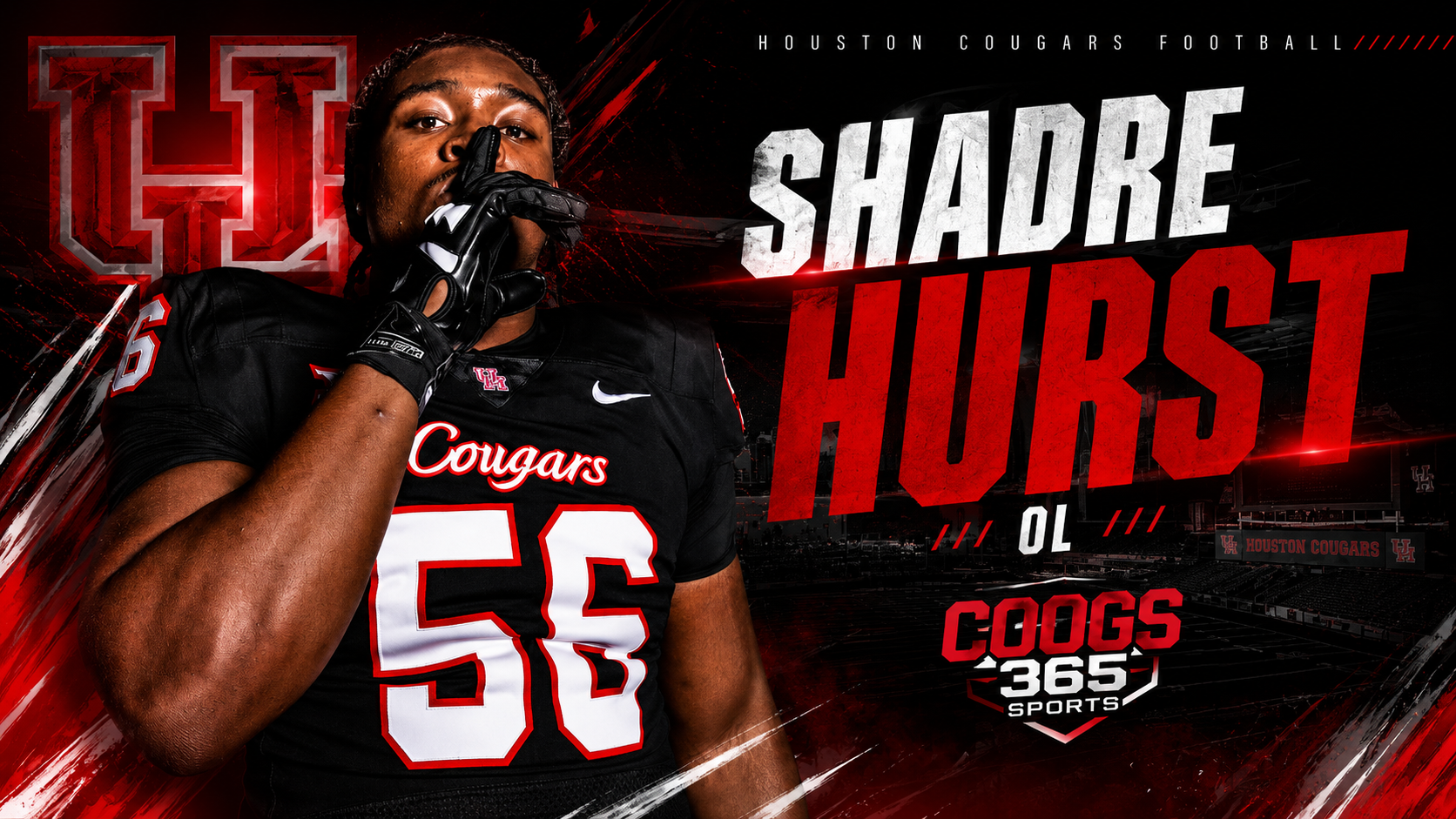
That is precisely why the arrival of Shadre Hurst could become one of the most important developments of Houston’s 2026 season.
The Cougars did not simply need additional depth in the trenches. They needed a proven difference-maker someone capable of immediately raising the standard of the room, stabilizing the interior and giving Houston an offensive lineman it can confidently run behind when the entire stadium knows where the football is going.
Hurst gives them exactly that. He arrives in Houston as one of the most accomplished interior offensive linemen in the country. A Sporting News Second-Team All-American in 2025. A former FWAA Freshman All-American. A two-time First-Team All-American Athletic Conference selection. A three-time conference champion.
Those honors tell part of the story.
The film tells the rest.
Hurst plays with the balance of a technician and the temperament of a wrestler. His hands are disciplined. His base is powerful. His feet remain active through contact. He does not simply absorb defenders; he redirects them, turns them, and removes them from the point of attack.
That distinction matters. There are offensive linemen who survive snaps. Hurst controls them.
In 2025, he finished as the highest-graded offensive lineman in the American Athletic Conference. Pro Football Focus graded him as the No. 6 guard nationally and the No. 9 overall offensive lineman in the country.
Those rankings are not built on one viral block or one dominant afternoon.
They represent sustained excellence across hundreds of snaps, the down-to-down consistency required to survive inside, where defensive tackles are stronger, spaces are tighter, and hesitation is punished immediately.
Hurst understands how to win there.
His addition gives Houston an immediate anchor in the interior of the offensive line. He can create movement in the run game, hold firm against power rushers and provide the kind of clean pocket quarterbacks need to step forward rather than drift into pressure.That last piece may become especially valuable.
Edge protection often receives the greatest attention, but interior pressure can destroy an offense faster than almost anything else. When a defensive tackle collapses the middle, the quarterback loses both his vision and his escape route.
Timing disappears. Routes are rushed. The entire structure of the play breaks down before it has a chance to breathe.
Hurst has the strength to absorb that initial surge and the body control to recover when defenders counter. He plays with a strong center of gravity, rarely allowing contact to knock him off his track.
Some of that comes from years of refinement on the football field.
Some of it was developed on a wrestling mat.
At Cartersville High School, Hurst was not only an all-state offensive lineman and two-way standout. He became one of the premier heavyweight wrestlers in the Southeast, finishing as a state runner-up during his junior season before winning a state championship as a senior.
That background is visible in nearly every part of his game.
Wrestling teaches leverage, balance, hand placement, and the ability to manipulate another athlete’s weight. It also teaches patience within physical chaos—the ability to remain composed while another powerful human being is attempting to move you against your will.
For an interior offensive lineman, there may be no better developmental laboratory.
Hurst understands angles because he has lived them. He understands how to generate force from the ground. He understands when to strike, when to reset and how to use an opponent’s momentum against him.
Most importantly, he understands how to finish.
Houston’s offense needs that edge.
The Cougars have enough skill and talent to create explosive moments. They have runners capable of making defenders miss and quarterbacks capable of attacking every level of the field. But talent on the perimeter only becomes dangerous when the offensive line gives it room to operate.
Hurst has already shown that he can be the foundation of that kind of offense.
Tulane ranked sixth nationally in sacks allowed per game in 2025, surrendering just 0.77. The Green Wave also ranked seventh nationally in tackles for loss allowed, giving up only 3.69 per game.
Those numbers speak to more than protection.They speak to offensive stability.
Negative plays are drive killers. A sack on first down changes the playbook. A tackle for loss behind schedule forces an offense to become predictable. Preventing those moments allows a coordinator to remain aggressive and keeps a defense from dictating the terms of the possession.
Hurst helps Houston stay on schedule.
In the running game, his impact could be even more immediate.
He earned one of the top run-blocking grades in the AAC in 2024 and continued to develop into a nationally elite interior presence the following season. He can displace defenders on downhill concepts, climb to linebackers with control and create the initial crease that allows a talented backfield to reach the second level.
That makes him a natural fit for an offense that wants to be physical without becoming one-dimensional.
Houston can run behind him on short yardage. It can use him on double teams. It can ask him to pull into space or secure the interior while the offense attacks outside. His presence expands the menu because coaches do not have to protect him with play design.
They can trust him to win.
That trust can spread across an entire offensive line.
A veteran lineman with championship experience changes more than one position. He changes preparation. He changes film study. He changes the expectations in the weight room and the communication at the line of scrimmage.
Hurst knows what winning football is supposed to look like because he has been part of three conference championship teams. He understands that offensive line play is built on five players operating with one heartbeat—seeing fronts the same way, passing off pressure without panic, and trusting the man beside them when the game tightens.
Houston needed that experience.
The Cougars also needed someone capable of bringing an edge to the most physically demanding room on the roster.
Hurst does not arrive as a developmental projection. He arrives as a finished, proven college football player who can step into the lineup and immediately become one of Houston’s most dependable offensive pieces.
His presence should make the players beside him better. It should give the quarterback greater confidence in the pocket. It should allow the running backs to press the line with patience instead of anticipating early penetration.
When Houston faces the most talented defensive fronts on its schedule, Hurst gives the Cougars someone who has already demonstrated that he can compete at an elite national level.
That may be the difference between an offense that flashes and one that endures.
Explosive plays will always fill the highlight reels. Quarterbacks will receive the praise. Running backs will cross the goal line, and receivers will celebrate beneath the lights. But before any of that happens, someone has to move another grown man against his will.
Someone has to protect the pocket when the defense brings pressure.
Someone has to win the fourth quarter when technique begins to fade and toughness becomes the deciding factor.
For Houston, that someone could be Shadre Hurst. The Cougars needed a boost in the trenches. They may have found the man capable of rebuilding the offense from the inside out.


