
There are still pockets of Texas recruiting territory where SEC logos don’t dominate Friday nights. South Texas has long been one of them. That’s where the trail first led when I started scouting 2027 EDGE Brayden Booth when Ole Miss had its eyes on him early. Now fast forward; the recruitment now looks dramatically different than it did a year ago.
At the time, Booth wasn’t even on the field. An injury had temporarily paused the rise of one of San Antonio’s most intriguing defensive prospects, forcing schools into evaluation mode instead of full pursuit. Some programs backed away entirely. Others decided to wait and see. But over the last year, the 6-foot-5, 220-pounder has done exactly what elite competitors do when adversity hits: he came back faster, stronger, and more explosive.
Now the rest of college football is scrambling to catch up. In my evaluation, Booth I stands as the No. 19 overall edge in the 2027 cycle—a long, disruptive edge defender whose ceiling continues to climb every time he steps on the field. The twitch off the edge jumps out immediately, but what separates Booth is how naturally he plays in space. He bends well, closes violently, and shows the type of lateral movement that translates to multiple defensive systems at the next level.
That combination is why his recruitment is beginning to accelerate nationally.
Booth officially begins a critical stretch of official visits tomorrow close to home as UTSA hosts him May 12-14. From there, Booth heads into a heavyweight month of visits with Kansas State (May 29-31), Baylor (June 5-7), North Carolina (June 12-14), and Georgia Tech (June 19-21). Booth has already circled Sept. 26 — his birthday — as commitment day.
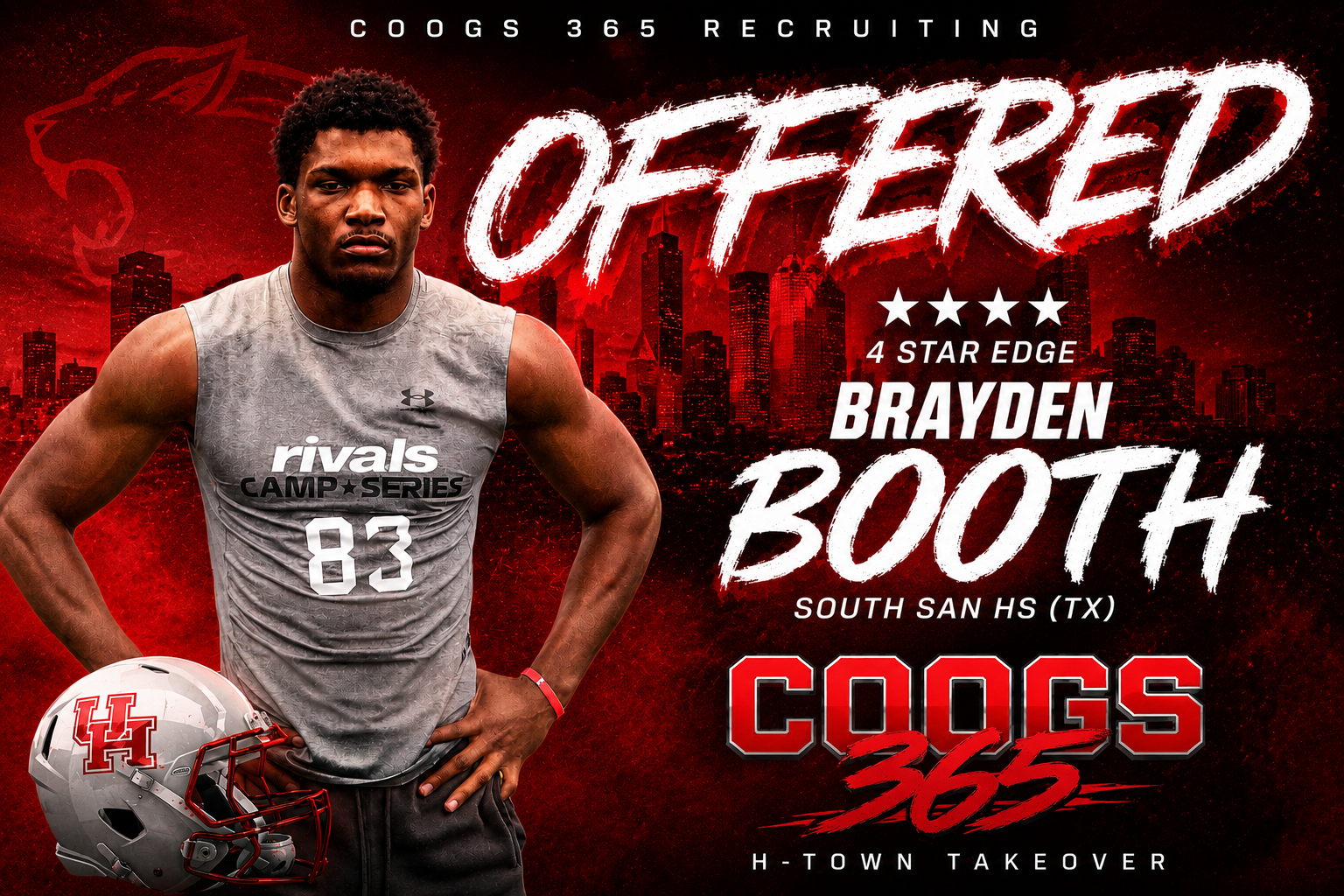
That timeline matters because while several Power Four programs have been steadily building relationships, the University of Houston officially inserted itself into the race Monday afternoon. And suddenly, one of the more fascinating late recruiting pushes in the state is underway.
Houston defensive line coach Oscar Giles knows this region as well as anyone in the business. He understands the kind of edge players South Texas can quietly produce before the national services fully catch on. That’s why this offer feels less like a flyer and more like a calculated late-stage swing from a staff that believes Booth’s trajectory is still climbing.
The challenge now becomes obvious: can Houston make up enough ground quickly?
Programs like Baylor and Kansas State have been involved earlier. UTSA has the hometown angle. North Carolina and Georgia Tech offer distance and ACC exposure. Houston, meanwhile, enters the fight later than most but not without advantages.
Willie Fritz’s staff can sell immediate vision, high-level development expectations in the trenches, and the opportunity to help build something significant inside a city that continues producing high-level talent.
Houston also has a chance to pitch proximity without feeling small. For many in-state prospects, that balance matters. Booth feels like the exact type of prospect that championship staffs regret missing three years later.
The recruiting industry loves polished rankings and early hype cycles. But every class has a handful of prospects who develop differently — players who get overlooked because the timeline didn’t perfectly align with the machine. Brayden Booth looks like one of those players.players. Now the question becomes whether Houston arrived early enough to pull off what would amount to a legitimate Coogs coup in South Texas.