
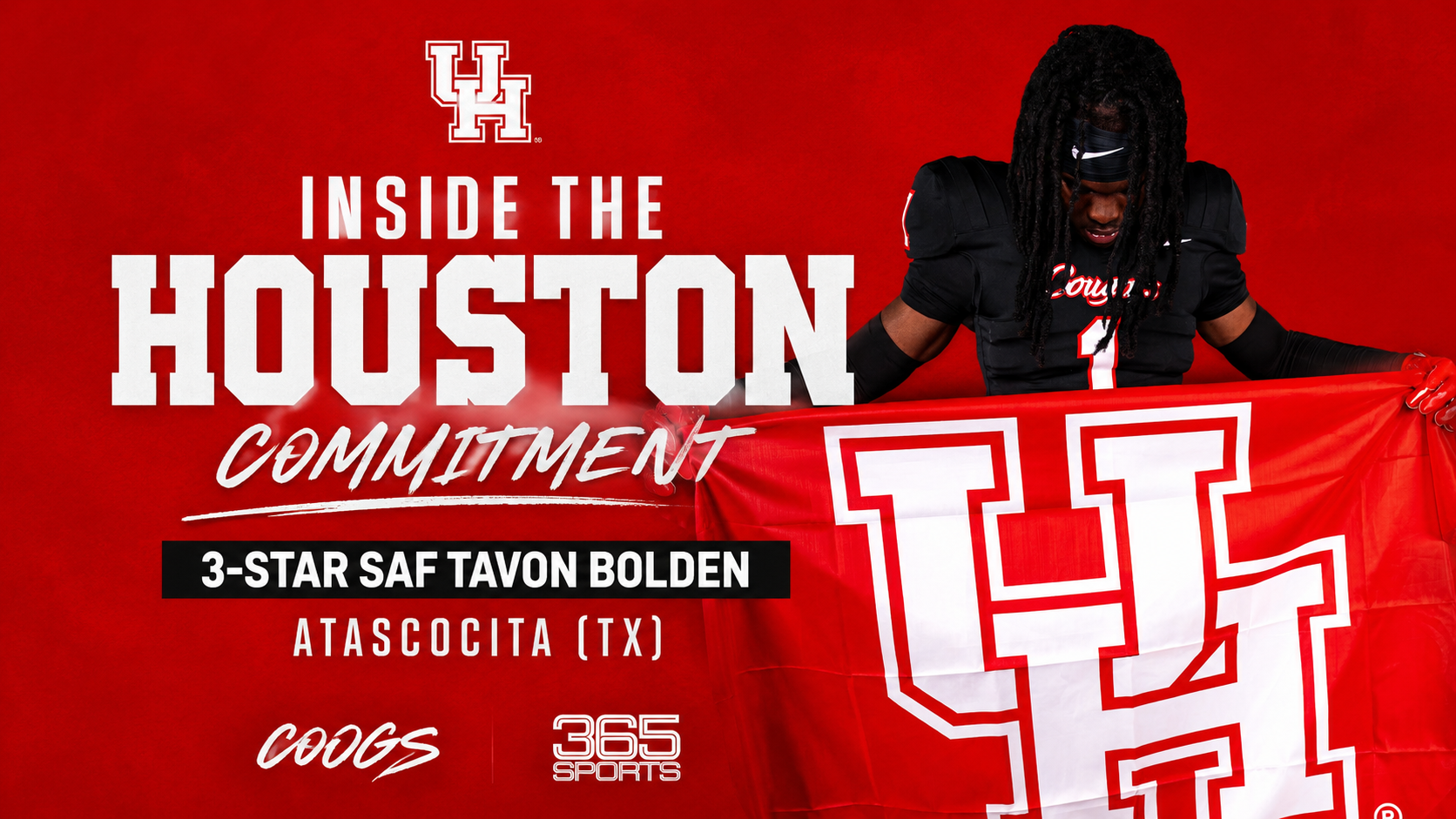
The recruiting industry is very good at telling you what a prospect is worth. It counts stars, assigns rankings, and reduces a young man's entire athletic identity to a number between one and five. It tracks offers the way a stockbroker tracks positions—always watching for the next move, the better deal, and the program that bids highest before the deadline.
What it cannot measure is what it has never figured out how to rank, which is the moment a kid stops feeling like a prospect and starts feeling like a person. That moment happened for Tavon Bolden. It happened at Houston. And the second it did, the decision was already made.
The three-star safety out of Atascocita didn't arrive at his commitment through a bidding war or a highlight reel fever dream. He arrived there through something the recruiting industry rarely quantifies but every great coach understands completely: consistency.
"They have just been recruiting me very hard since they first offered me," Bolden said, "and every time I talk to them and go up there, they never change — and they treat me like family."
They never change. Read that again, slowly.
In a landscape where a phone call from a Power Four school can rewrite a young man's entire worldview overnight, where the pursuit of a prospect is often elaborate theater that dissolves the moment a verbal is signed and bolden notices the thing that is hardest to fake over time.
The Cougars showed up the same way on the hundredth conversation as they did on the first. No bait-and-switch, no cooling of enthusiasm, no sudden recalibration of interest once a shinier name appeared on the board. Just steady, honest pursuit. Consistency is not glamorous. But it is everything.
Every commitment has a fulcrum and a single relationship, a single voice, that tips the scale. For Bolden, that voice belonged to Coach Hall.
"My relationship with Coach Hall definitely impacted my commitment," Bolden said. "He's just an overall great person and coach. We had a great bond ever since I got offered ."
There's a reason that sentence carries weight. Coaches recruit with language, with promises, with vision. The great ones recruit with character, and character, unlike language, cannot be rehearsed indefinitely without cracking. What Bolden found in Hall was not a salesman. He found a man whose goodness held up under the scrutiny of time and repeated interaction.
A great bond is built on a first offer and sustained through months of visits and phone calls and late-night conversations about football and life and where a young man sees himself, and that bond does not emerge from strategy sessions. It emerges from two people who are genuinely aligned, not just aligned on paper.
In the modern recruiting game, where kids are simultaneously managed and marketed to, where their decisions become national content before the ink dries, finding a coach who meets them as a person first is rarer than any star rating suggests. Bolden found that in Hall and he didn't let it go.
But the head makes promises the heart must ratify and for Bolden, the heart made its declaration during a moment that had nothing to do with highlight films or depth charts or coaching staffs. It happened when he was with the players.
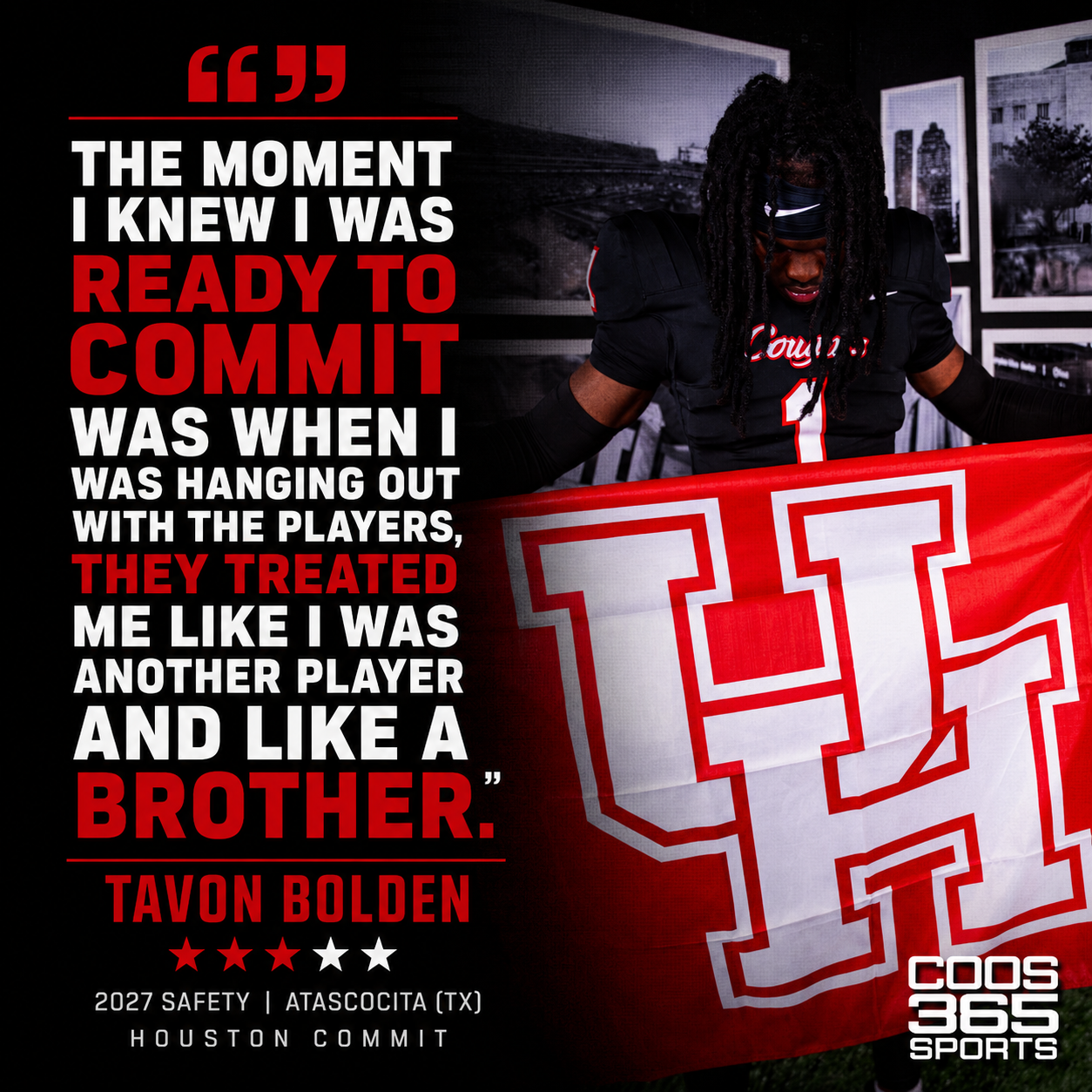
This is the detail that separates programs that win from programs that just recruit. Culture is not a poster on a weight room wall. It is not a motto embroidered on a hoodie or a coordinator's PowerPoint slide. Culture is how a team treats a kid who isn't yet one of them. Culture is the door that swings open before the ring is earned.
When Bolden stepped into that environment and felt the embrace of players who had nothing to gain from impressing him, who simply welcomed him the way they would a teammate, the decision crystallized. You cannot manufacture that moment. You cannot script it or plan it or produce it for a recruiting visit. It either exists in a locker room or it doesn't. At Houston, for Tavon Bolden, it existed.
The question every commitment eventually answers is not just where but why now, why here, why this. For Bolden, the answer is uncomplicated in the best possible way.
"What I'm mostly looking forward to as a Cougar," he said, "is to be with the team and get to work."
There is something almost old-fashioned about that — the idea that the destination of a recruiting journey is not the announcement, not the hat on the table, not the Twitter moment, but the work itself. The grind. The Tuesday morning film sessions and the fourth-quarter conditioning runs and the thousand invisible repetitions that build a player from a prospect into a cornerstone.
Bolden is not arriving at Houston to experience the Cougars. He is arriving to become part of them.
"I feel like it's the right move," he said, "because we're all in it for the same reason — to win and to make each other better."
That is not a teenager reciting a coaching staff's talking points. That is a young man who has diagnosed something real about the environment he is walking into and decided he wants to live inside that purpose. Collective ambition. Mutual elevation. The rare and beautiful alignment of individual hunger with team identity.
Three stars on a recruiting service's website tell you something about Tavon Bolden—his measurables, his film, his potential. It tells you he is good. It does not tell you what kind of competitor he is, what kind of teammate he intends to be, or what it means to a kid from Atascocita to be treated like a brother before he has played a single down.
But if you pay attention to the words he uses—they never change: "great bond," "like a brother," "get to work," and "make each other better"—a portrait emerges. Not of a recruit. Of a player.
Houston didn't just land a commitment on Sunday. They found the guy who was looking for exactly what they're building.