

Willie Fritz remembers what it felt like. Two years ago, he walked into a Houston program that had gone 4-8 the season before he arrived, inherited a roster with more questions than answers, and understood the way every coach who's done this a half-dozen times understands that year one was going to be about survival, not style points.
He went 4-8 again. Nobody panicked. Not really. Because Fritz has built this exact story before: two years at Georgia Southern, six years at Tulane, and a ceiling that always seemed to arrive on a delay. On September 5, he'll stand on the opposite sideline from a man living that same delay in real time.
JaMarcus Shephard took his first head-coaching job in December, at a program that got left for dead by realignment and is still figuring out which century it's rebuilding into. Thirty-five Oregon State players walked out the door via the transfer portal after a 2-10 season. Thirty-seven walked in behind them.
Shephard, an offensive mind who cut his teeth as a position coach and coordinator at some of the sport's biggest addresses, spent spring camp doing something most first-year coaches dread saying out loud: he told reporters he had no intention of naming a starting quarterback until fall camp ended because his linemen and his three quarterback candidates were still learning each other's names.
That's not a criticism. That's just what year one looks like. Fritz knows it better than almost anyone in the building.The difference is, Houston isn't in year one anymore.
What Two Years Buys You
The Cougars enter this opener carrying the kind of momentum that changes how a fan base talks about a season before it starts. Last year's 10-3 finish capped by a wild 38-35 win over LSU in the Texas Bowl wasn't a fluke season for Fritz's program so much as it was the moment the rebuild's math finally cleared.
We Big 12 beat writers put Houston third in the conference this preseason. Sportsbooks have them a shade lower, but not by much, and the gap between "dark horse" and "the real thing" in Houston is now measured in inches.
At the center of it is Conner Weigman, and his story is its own kind of homecoming. A five-star quarterback out of Cypress who spent three injury-shortened years at Texas A&M without ever fully becoming himself, Weigman came home and, for the first time in his career, got to just play football. The results were emphatic: 2,705 yards, 25 touchdowns, nine interceptions, and better than 65 percent completion.
He's already told people this is where he wants to stay. There's no mystery left in that decision, and there shouldn't be; few quarterbacks get a redemption arc this clean.
Around him, the pieces got better, not worse. Amare Thomas, who quietly had one of the best receiving seasons in the conference (67 catches, 966 yards, 12 scores), returns as the go-to target. The offensive line got an overhaul: Toledo's Anthony Boswell, Tulane's Shadre Hurst, and Miami (Ohio)'s Drew Terrill all arrive to replace departed starters, with Hurst already drawing preseason All-Big 12 recognition before he's played a snap in Houston red.
Then there's Makhi Hughes, who might be the most interesting name on this entire roster and the one storyline nobody outside the program is tracking closely enough. Hughes ran for 1,401 yards and 15 touchdowns for Fritz at Tulane in 2024, a legitimate star. Then he transferred to Oregon, chasing a bigger stage, and never cracked the rotation.
A year later, he's back with the coach who made him, in an offense that already knows how to feature a running back, on a team that suddenly has a real conference title in its sightlines. If that reunion works the way both parties are betting it will, Houston stops being a quarterback-and-hope offense and becomes something closer to unguardable.
The Ghosts of Corvallis
There's a smaller story buried in here, the kind that never makes a broadcast's graphics package but always ends up mattering to the players involved. A year ago, Houston went into Reser Stadium and beat this same Oregon State team on the road.
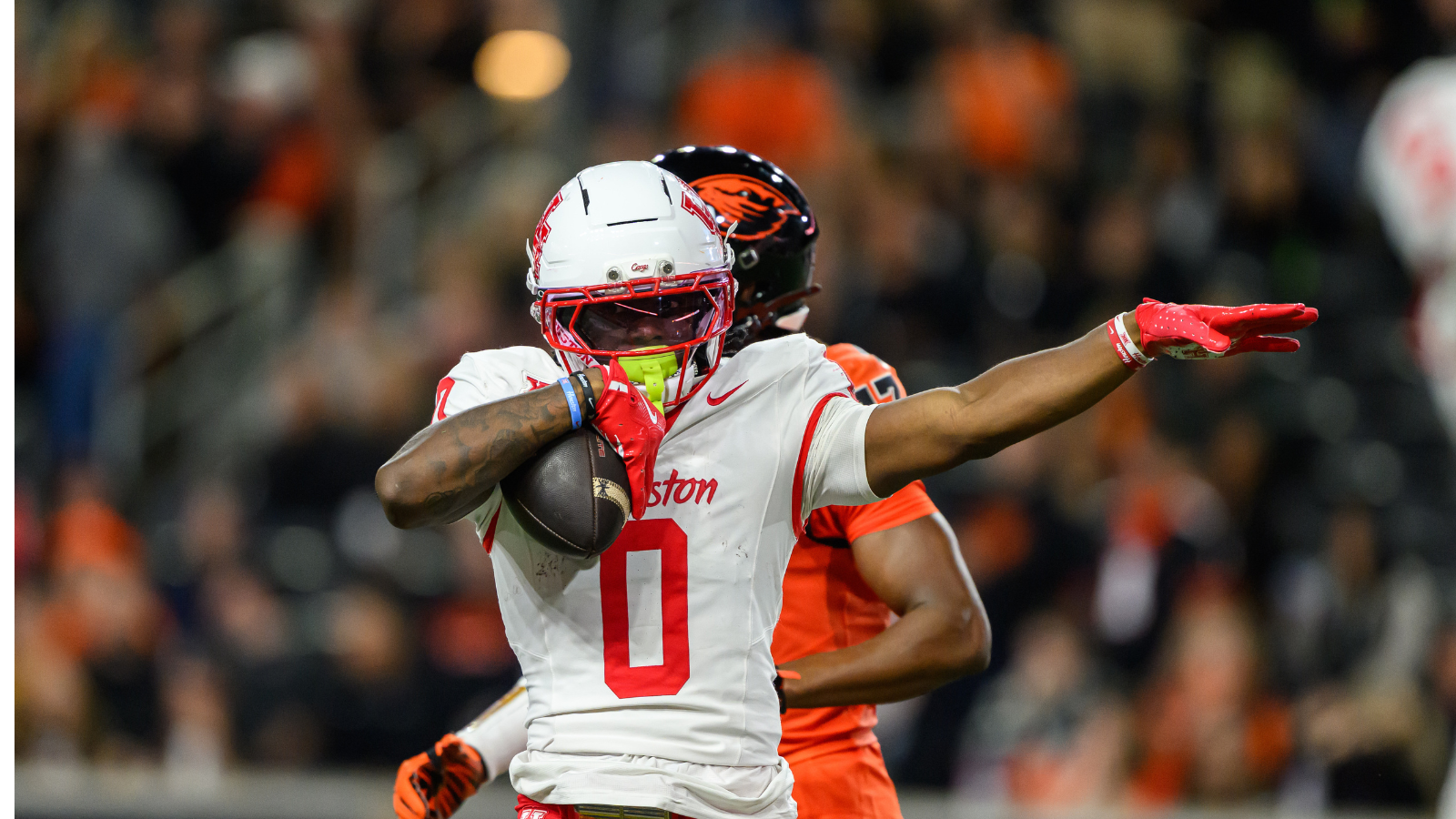
One of the players on the other sideline that day was Trent Walker, a receiver who caught 823 yards worth of passes for the Beavers, their leading returning producer, at least on paper, before the entire roster turned over. Walker is a Cougar now. He'll take the field in Houston red against the program that developed him, against a secondary that has never faced him in practice, because none of them were on the roster last year either.
Nobody's putting that on a hype poster. But somewhere in pregame warmups, that's the matchup that means something.
What Happens at Kickoff
Strip away the storylines, and this is a football problem with a fairly obvious answer. Oregon State's biggest question, who plays quarterback, won't be resolved until fall camp closes, and whoever wins that competition will be throwing behind an offensive line that's still learning to communicate protections with him for the first time.
Houston's defensive front doesn't need to disguise much against that kind of unfamiliarity; it just needs to be fast and be patient and let confusion do the rest of the work. If the Beavers can't buy their new quarterback time in the first quarter, this game stops being competitive by the second.
On the other side, Houston's own questions about a retooled offensive line and new pieces in new spots are the good kind of questions.
They're the kind that get answered by a roster that already knows its quarterback, already knows its top three targets, and already has a proven system underneath it. Continuity beats installation almost every time in a Week 1 game, and Houston has all the continuity in this matchup.
Books have installed Houston as roughly a 19.5-point favorite, with the total sitting near 50.5, numbers that read less like a coin flip and more like an acknowledgment that one program is finishing a build and the other is just pouring the foundation.
The Call
Weigman finds Thomas or Walker early to make the safeties respect the pass, which opens exactly enough room for Hughes to remind the conference what a Fritz-system running back looks like when he's fully healthy and fully trusted. Houston's front seven turns Oregon State's still-unsettled quarterback situation into a long afternoon of second-and-long. By the fourth quarter, this has the shape of a tune-up, not a test.
Houston 41, Oregon State 17.
Somewhere in the fourth quarter, Fritz will look across the field and see a version of himself he doesn't have to be anymore, a coach still teaching his team how to lose before it can learn how to win. He's already made that walk. Now he just has to remember it's still going on, forty yards away, on the other sideline. The schedule stops being kind the very next week. But on this Saturday, Houston doesn't have to be the underdog story anymore. It gets to be the proof.


