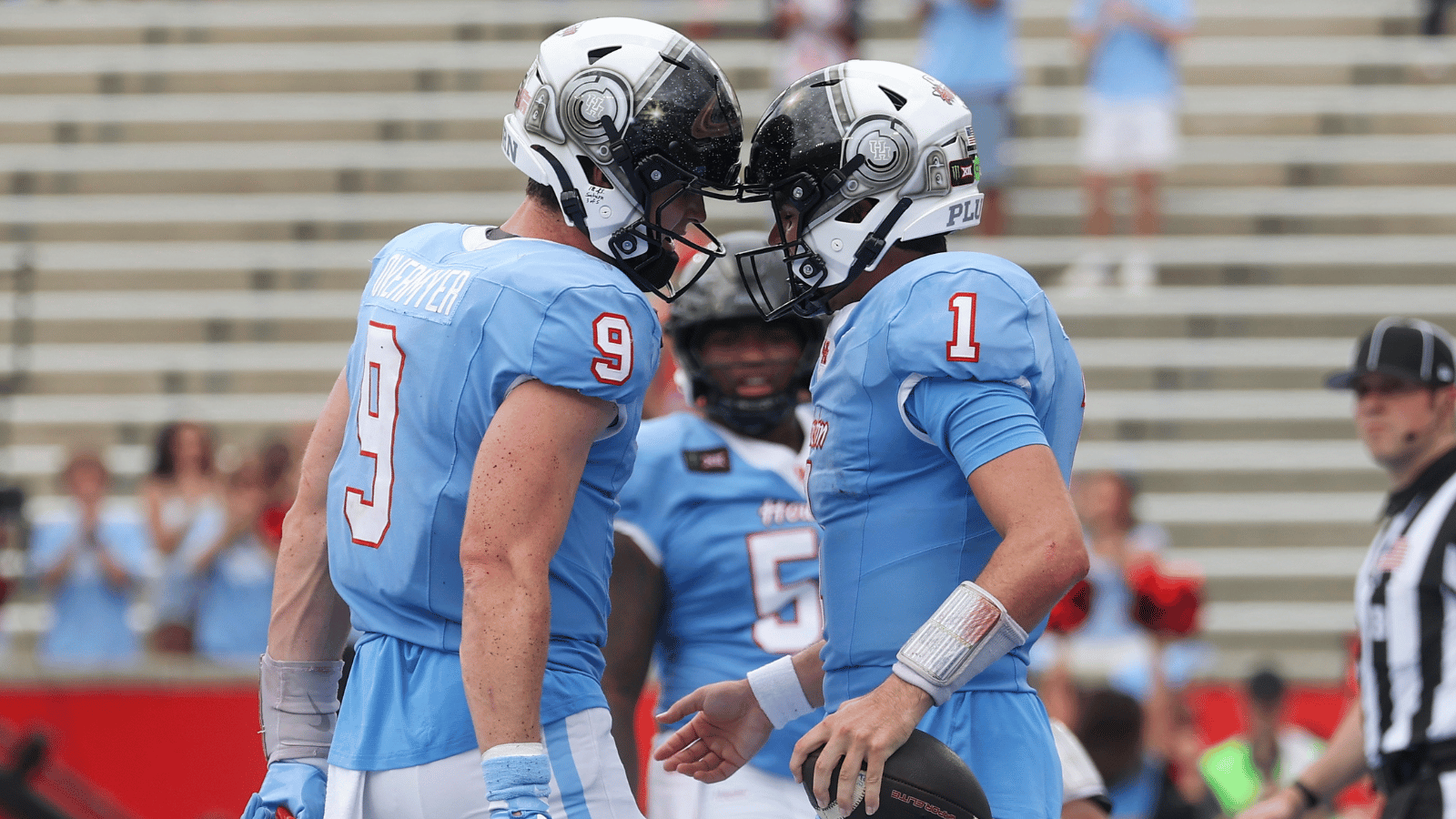

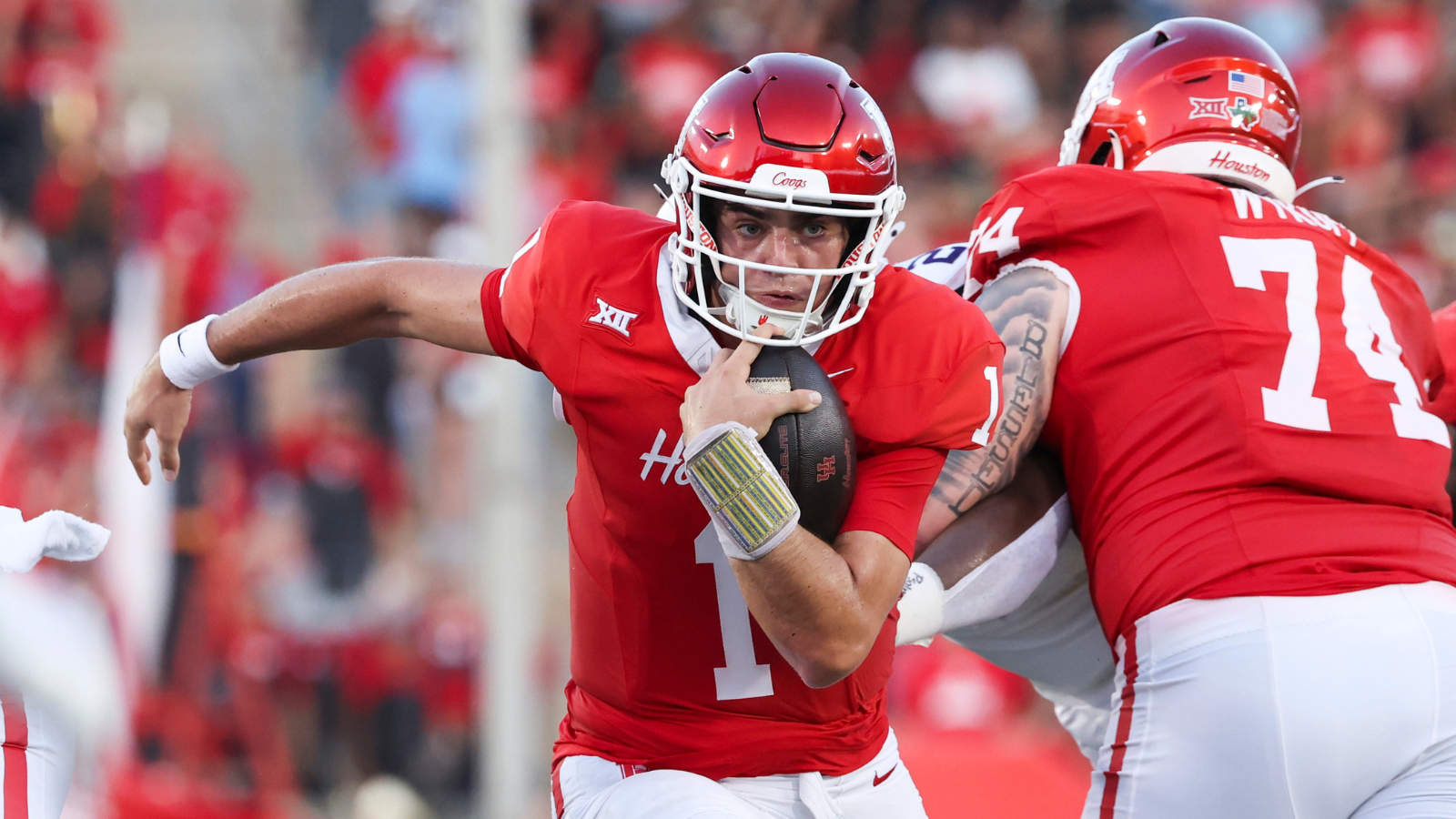
The football is in the air before the cornerback finishes his break. That is the detail. That is the whole story, really, compressed into a single instant that most people watching will never notice and every quarterback coach in America will rewind three times before moving on.
Nobody throws it before the window opens unless they already saw the window coming. Not talent. Not instinct alone. Something rarer and harder and more expensive than either is the specific kind of trust that a quarterback builds in an offense over years of repetition, years of film, and years of a coach standing ten yards away saying the same thing in the same voice until it stops being instruction and becomes belief. That is what you are watching when Conner Weigman releases the ball early. You are watching Weigman in Willie Fritz's program expressing itself in nine-tenths of a second.
The rest of the Big 12 is about to find out what that means in November.
Go back to College Station, because you have to. You cannot tell this story without the place it almost ended in.
Weigman arrived at Texas A&M carrying everything the sport places on a quarterback before he had earned the right to carry it. The recruiting rankings. The television segments. The message board mythology that accretes around five-star prospects the way barnacles accrete on the hull of a ship that are heavy, invisible, and corrosive over time. He was the best quarterback prospect in the country coming out of Bridgeland. The arm was real. The release was real. The athleticism was real. The mechanics were so clean that SEC evaluators were already sketching out first-round grades before he had thrown a single meaningful pass in college.
Then A&M did what A&M does.
Not out of malice. The SEC accelerates everything — development, failure, scrutiny, consequence—and it does so indifferently, the way a river accelerates over a falls. Weigman came in raw, and the environment ground against him, and the coaching staff changed, and the offense changed, and the injuries came, and what never came was the one thing a young quarterback needs above every physical gift he possesses: the chance to run the same system, with the same people, in the same language, long enough that he stops thinking and starts knowing.
He was not failing. He was thinking. And at the highest levels of this game, there is almost no difference between the two.
Watch the tape from those A&M years, and you can see it happening in real time, the way you can see weather change over open water. His eyes worked through the reads sequentially, one, two, and three, and instead of processing the field as a whole and arriving at the answer before the defense finished asking the question. His feet were never quite settled. His shoulders turned fractionally too early on throws over the middle, telegraphing routes to defenders who were paid to read exactly that tell. The talent kept flashing through the arm, the release, and those rare clean pockets when everything slowed down and he looked exactly like the prospect the rankings promised, but the structure around him never held long enough for the flashes to become a fire.
He transferred to Houston having proven nothing except that the environment was wrong. Which, as it turned out, was the most important thing he could have proven.
The Fritz Doctrine
Willie Fritz has been coaching football for nearly four decades and has exactly zero interest in being celebrated for any of it. He is the kind of coach the sport used to produce in abundance and now produces almost not at all—a man who genuinely believes that process precedes result, that identity precedes talent, and that the most valuable thing a coach can give a quarterback is not a scheme or a system but an environment in which the quarterback learns to trust himself completely.
That sounds like philosophy. It is, in fact, a technical argument.
Because what Fritz understood about Weigman — what he saw in the film, in the practice reps, in the early meetings when he was mapping the landscape of what this quarterback actually was versus what two years of chaos had made him look like — was that the processing problem was not a talent problem.
It was a confidence problem wearing a talent problem's clothes. Weigman did not need a new offense. He did not need new mechanics. He did not need to be rebuilt from the ground up the way a coaching staff sometimes does with a quarterback whose foundational habits have calcified wrong.
He needed to stop waiting for confirmation of what he already knew.
What the Film Shows
The single most measurable change in Weigman from A&M to Houston is the timing of his weight transfer at the moment of release. At A&M, his weight moved fractionally after the decision. A tell that he was confirming his read rather than trusting it. At Houston, his weight and his decision move together. That synchronization is the physical expression of cognitive trust. You cannot fake it and you cannot coach it directly.
It emerges from repetition inside a system a quarterback believes in completely. When NFL scouts look at Weigman's tape from last season, that synchronization is the first thing they find. Everything else—the arm, the athleticism, the touch on the back-shoulder—they already knew about. The timing is new. The timing is what changes his draft conversation entirely.
Fritz ran the offense. Every day. The same language. The same reads. The same demands: trust what you see, get the ball out on time, take the six yards in front of you instead of hunting the twenty that might not be there. Do not improvise. Do not force. Do not audition. Play football the way it is drawn up and trust that the drawing is correct.
Modern college football rarely allows a quarterback to grow this way. The sport has become allergic to patience. It wants Heisman moments and viral highlights and the kind of production that generates momentum in the transfer portal and keeps boosters excited through the winter. Fritz coached Weigman the old way, demanding command, demanding accountability, and demanding the specific and unglamorous kind of toughness that does not photograph well and absolutely wins football games. It took months. Then it took hold.
The Athlete Nobody Remembered
There is a version of this story that focuses entirely on the cerebral evolution and misses the physical one entirely, which would be a significant editorial error. Because one of the quietest developments of the last two years—buried under the processing conversation, underreported in the offseason previews, almost entirely absent from the national analysis—is the athlete Weigman quietly became again once the injury history stopped accumulating and the practice reps started.
Fritz mentioned it almost in passing during a spring session, the way coaches mention things they find interesting but do not yet want to fully advertise: a GPS reading during offseason conditioning work. Twenty-one miles per hour.
Sit with that number for a moment before moving on.
Twenty-one miles per hour is not a running back. It is not designed to carry speed. What it is and what it means in the context of a quarterback who is also now processing at an elite level inside a scheme he trusts completely is leverage. It means defenses cannot commit to coverage rotations the way they would against a pure pocket passer.
It means the linebacker who crashes the box on a run fake cannot fully commit, because the man he is supposed to be covering is fast enough to hurt him. It means interior pressure that would collapse the pocket against a conventional quarterback instead produces a clean seven-yard scramble that moves the chains and changes field position and costs the defense exactly the kind of psychological momentum it was trying to manufacture.
He did not become a runner. He became unpredictable. In football, unpredictability is the only thing that cannot be schemed away.
Think of Bo Nix in his final college season. Think of Sam Ehlinger. The mobility that defined their late careers was not new. It was not some physical gift that emerged in year four. It was existing athleticism finally weaponized by experience: the ability to know exactly when to hold the pocket, exactly when to move, and exactly how to use space as a diagnostic tool rather than an escape route. That is the evolution happening in real time with Weigman, and the Big 12 has not yet reckoned with what it means.
The Team Built for the Man
The addition of Makhi Hughes to the Houston backfield this offseason is the final structural piece of an offense being constructed around a specific kind of danger. Fritz has always understood and has built his entire coaching philosophy around the understanding that the quarterback position expresses itself most completely when the defense is not free to focus on it exclusively.
A physical run game does not merely produce yards. It produces hesitation. It forces safeties to declare their intentions earlier. It keeps linebackers honest enough that the intermediate passing windows Weigman operates in so cleanly stay open a critical fraction of a second longer.
Hughes gives Houston the threat it needs to make defenses honest. Defenses that are forced to be honest against Weigman right now and defenses that cannot stack the box, cannot play two-high all day, and cannot deploy the coverage packages specifically designed to take away the middle of the field are defenses that are already losing the structural argument before the snap. Fritz has spent two years removing obstacles from between Weigman and his own abilities. He has removed the last one.
Now Comes the Hard Part
Last season, Houston surprised people, and that sentence carries more strategic weight than it appears to. "Surprised" means the preparation was inadequate. "Surprised" means the film sessions were too short and the game plans too generic and the coverage calls not yet tailored to the specific tendencies of the specific quarterback lining up on the other side of the ball. In 2025, defensive coordinators spent portions of their week on Weigman.
In 2026, every coordinator Houston faces will spend the entire week on him. The game plans will be surgical. They will identify his preferred reads, his hot-route tendencies under pressure, his comfort zones in the route tree, and the footwork tells that betray his decision before the ball moves.
Good coordinators will find things. They always find things. The question that has never been answered about Conner Weigman—the question that two years in Houston have finally made worth asking—is what he finds back.
This is the examination every elite quarterback must eventually pass.
Not in the spring. Not in the non-conference schedule. In October, on the road, down by a score, when the game plan being executed against you is more precise than anything you prepared for and the crowd is loud and the first two answers you planned to use have already been taken away.
What do you do with the third answer?
The Conner Weigman who arrived in College Station did not have one. He was still building the vocabulary of the offense, still learning to trust the reads, still finding out whether the talent that made him the most coveted quarterback prospect in the country could survive contact with the reality that talent, alone, has never been enough.
The Conner Weigman who lines up for Houston this fall has been answering that question every day in Willie Fritz's program, in Fritz's film room, and in the repetitions that quietly accumulated while the rest of the sport was looking somewhere else for its stars.
He has the answer. You can see it in the way he carries himself at the line of scrimmage. You can see it in the way his teammates orient themselves around him in the huddle, the specific and unmistakable body language of men who trust the person holding the ball. You can see it in the settled certainty with which Fritz talks about him—not with a coach's careful optimism, but with the flat authority of a man describing something he has already watched happen a hundred times and expects to watch happen a hundred more.
The football is in the air before the cornerback finishes his break. That is the detail. Watch it happen in November, in a stadium that is trying to make Conner Weigman hesitate, and understand what you are seeing: a quarterback who stopped waiting for confirmation of what he already knew, in a program built by a coach who believed that before anyone else did, in a city that has never once in its history cared what you were supposed to be.
Only what you are.