
There is a certain kind of quarterback beginning to take over modern college football — not just passers, not just athletes, but creators. Quarterbacks capable of surviving chaos, extending plays, and turning broken structure into explosive offense.
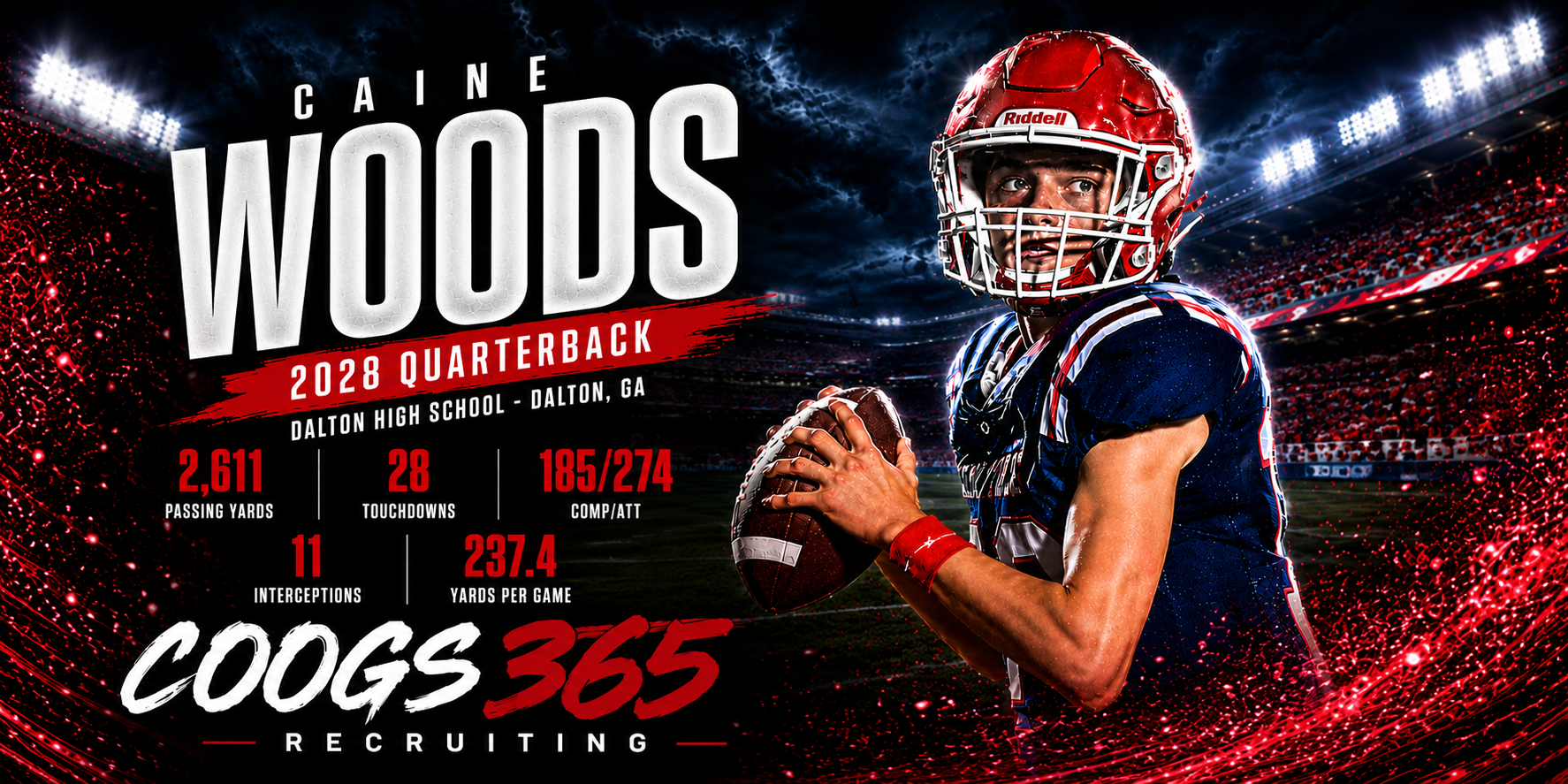
Watching 2028 quarterback Caine Woods out of Dalton High School, the flashes of that modern profile are already there. The production already backs it up.
Woods finished the season throwing for 2,611 yards and 28 touchdowns while completing 185-of-274 passes. He averaged 237.4 passing yards per game and consistently showed the ability to push the football vertically while operating with efficiency. For a young quarterback still early in his development, those numbers are significant because they reflect both volume and command of the offense.
https://twitter.com/CaineWoods2028/status/1984305191567437899?s=20
For a young quarterback, Woods plays with uncommon natural rhythm. The arm talent jumps off the tape immediately. The release is compact and easy; the ball comes out with life, and he already shows the ability to attack different levels of the field without overstriding or forcing throws mechanically. But what separates Woods from many young quarterbacks in his class is what happens after the play breaks down.
That is where his ceiling starts becoming intriguing. Woods is not simply a dual-threat quarterback who relies on athleticism once pressure arrives. He keeps his eyes downfield, resets naturally on the move, and understands how to manipulate defenders in space before making a decision. Those instincts are difficult to teach and increasingly valuable in today’s game, especially in conferences like the Big 12, where tempo, spacing, and quarterback creativity dictate offensive success.
That is also why his fit inside Houston Cougars football head coach Willie Fritz’s offensive identity makes so much sense long-term.
Houston’s offense is built around pressure points. Quarterbacks are asked to operate in RPO concepts, extend plays outside structure, threaten defenses with movement, and create explosives vertically. Woods already flashes many of those traits early in his development.
On tape, the Dalton signal-caller shows:
Off-platform throwing ability
Natural play extension instincts
Vertical touch and arm elasticity
Functional mobility in space
Competitive toughness versus pressure
The baseball background also shows up consistently in his mechanics. Multi-sport quarterbacks often develop better rotational sequencing and body control, and Woods flashes both. The arm angles, the torque generation, and the ability to throw accurately while moving all hint at a quarterback whose ceiling rises as his frame and mechanics continue developing. That is why Woods feels like a player the Big 12 should monitor closely moving forward.
The conference has evolved into one of the most quarterback-driven leagues in college football. Defenses are forced to defend space horizontally and vertically every snap. Quarterbacks who can create outside structure have become premium assets, and Woods possesses those early traits naturally.
He is still developing. The 11 interceptions on the stat sheet reflect the natural learning curve young quarterbacks face when balancing aggression with decision-making. But that willingness to challenge windows and attack defenses vertically is also part of what makes his upside so intriguing long-term.
Houston under Fritz is trying to build an offense that can stress defenses athletically while still creating explosive passing opportunities. Woods fits that blueprint because he does not need perfect structure to impact a football game.
For a 2028 quarterback, that combination of production, arm talent, creativity, and modern offensive fit makes Caine Woods one of the more intriguing young quarterbacks to watch nationally over the next few recruiting cycles.